
William (Billy) Dunne of Coolaghy (1889-1918)
EARLY YEARS IN IRELAND
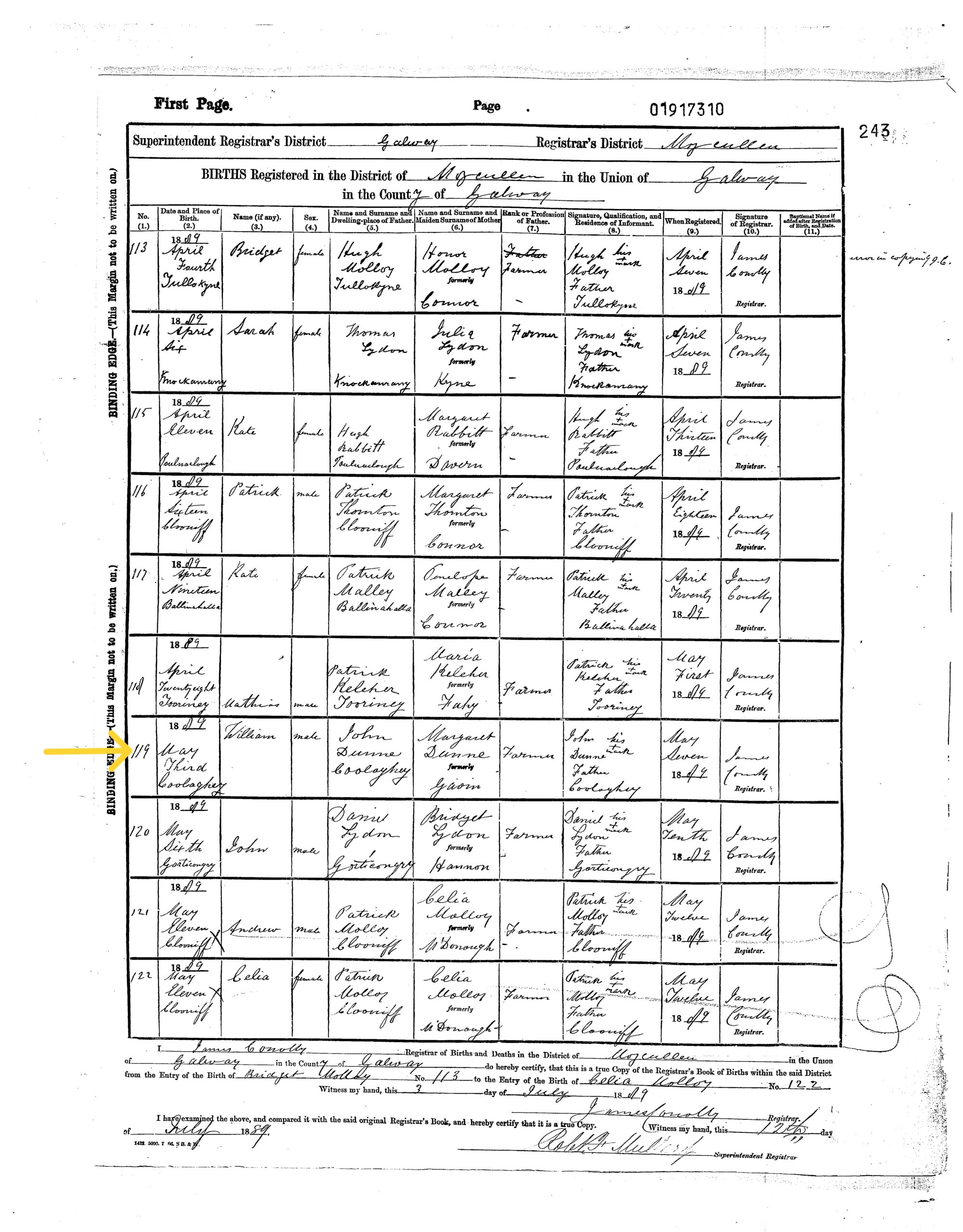
William Dunne was born on 3 May 1889 at Coolaghy, Moycullen, to John Dunne and Margaret Gavin. He was baptised the same day, with Thomas Dunne and Margaret Barrett serving as sponsors.
At the time of the 1901 census, William was living with his parents in Knockaunranny, Moycullen. Also present in the household were his brothers Patrick, Michael, Martin, and Bartley, his uncle Michael Dunne, and his paternal grandmother Julia Dunne. His younger brother Denis had sadly died the previous year from measles, aged just four years.
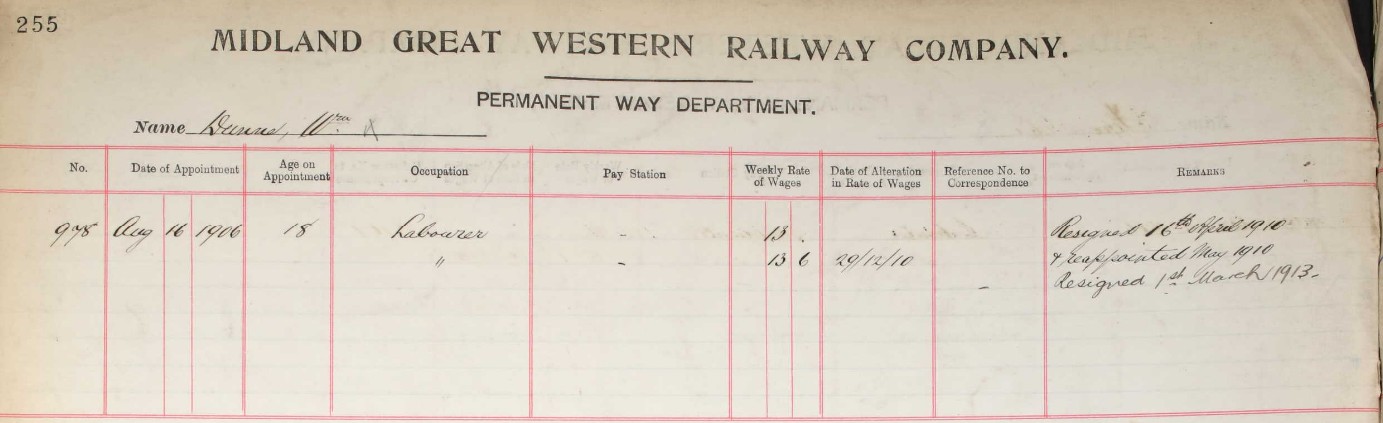
William began working for the Midland Great Western Railway Company as a labourer on 16 August 1906, employee number 978. At that time, he earned a weekly wage of 13 shillings. He resigned from his post on 16 April 1910, though the reason is not recorded. The following month, he rejoined the company, this time with a slight raise to 13 shillings and sixpence per week.
By the time of the 1911 census, tragedy had cast a long shadow over the family. William’s father had been found deceased by a milesman on the Galway–Clifden railway line at Coolaghy on 18 July 1906. Less than a month later, heartbreak struck again with the death of William’s brother Michael, aged just eighteen, from heart complications. Earlier, in 1902, his brother Martin had died of pneumonia at the age of eleven.
According to their mother’s entry on the census, she had given birth to nine children, of whom only five were still living—suggesting another sibling had died in infancy, though no birth or death records have been found to date.
In 1911, William was still residing with his widowed mother, now at Knockbane, along with his paternal grandmother Julia and siblings Patrick, Bartley, Julia, and Peter. At this time, William listed his occupation as a platelayer (with the Midland Great Western Railway Company), a position from which he resigned on 1 March 1913.
EMIGRATION
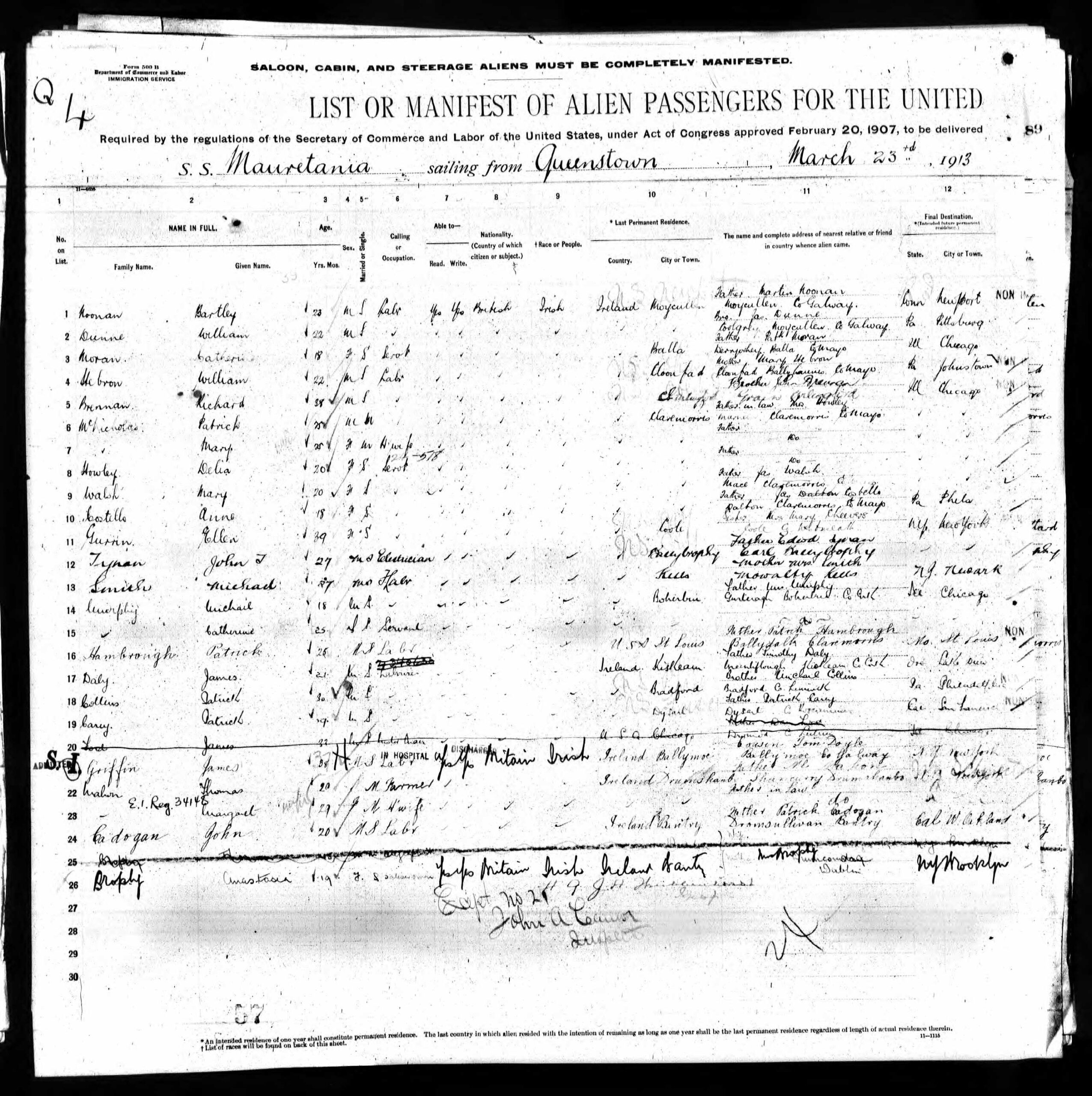
Just a few weeks later, on 23 March 1913, he boarded the RMS Mauretania at Queenstown (Cobh), County Cork, bound for New York. Traveling with him was Bartley Noonan (Noone), son of Matthias and Mary Noone, from Coolaghy, Moycullen. William’s stated destination was Pittsburgh, Pennsylvania, while Bartley was heading for Newport, Connecticut.
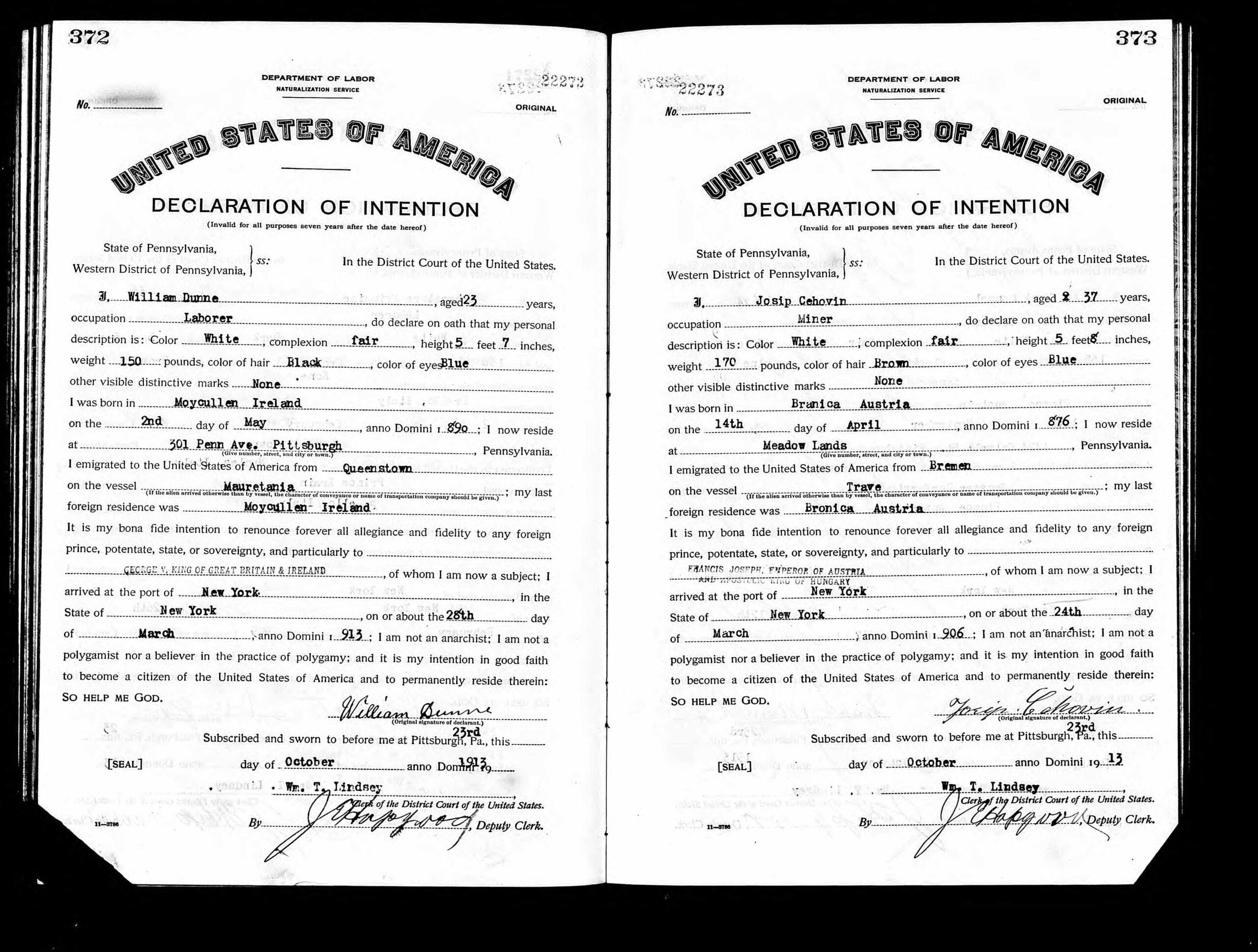
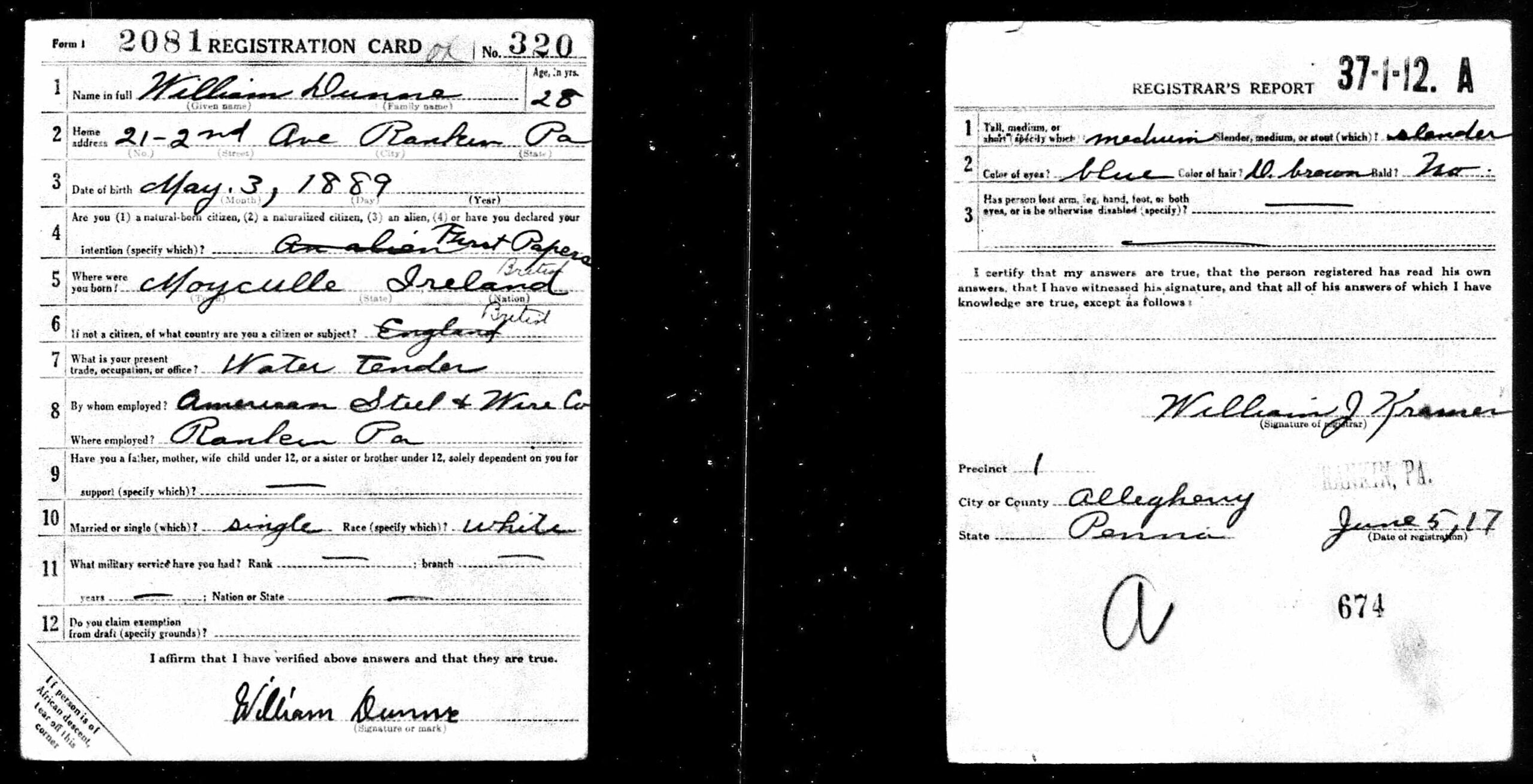
On 23 October 1913, William—then living at 301 Penn Avenue, Pittsburgh—swore his Declaration of Intention to become a U.S. citizen. Document No. 22272 offers a glimpse of his appearance: he stood 5 ft. 7 in. tall, weighed 150 lbs., and had a fair complexion, black hair, and blue eyes.
Between 1913 and 1917, William relocated to 21 2nd Avenue, Rankin, Allegheny County, Pennsylvania, where he worked as a water tender for the American Steel & Wire Company.
ARMY LIFE
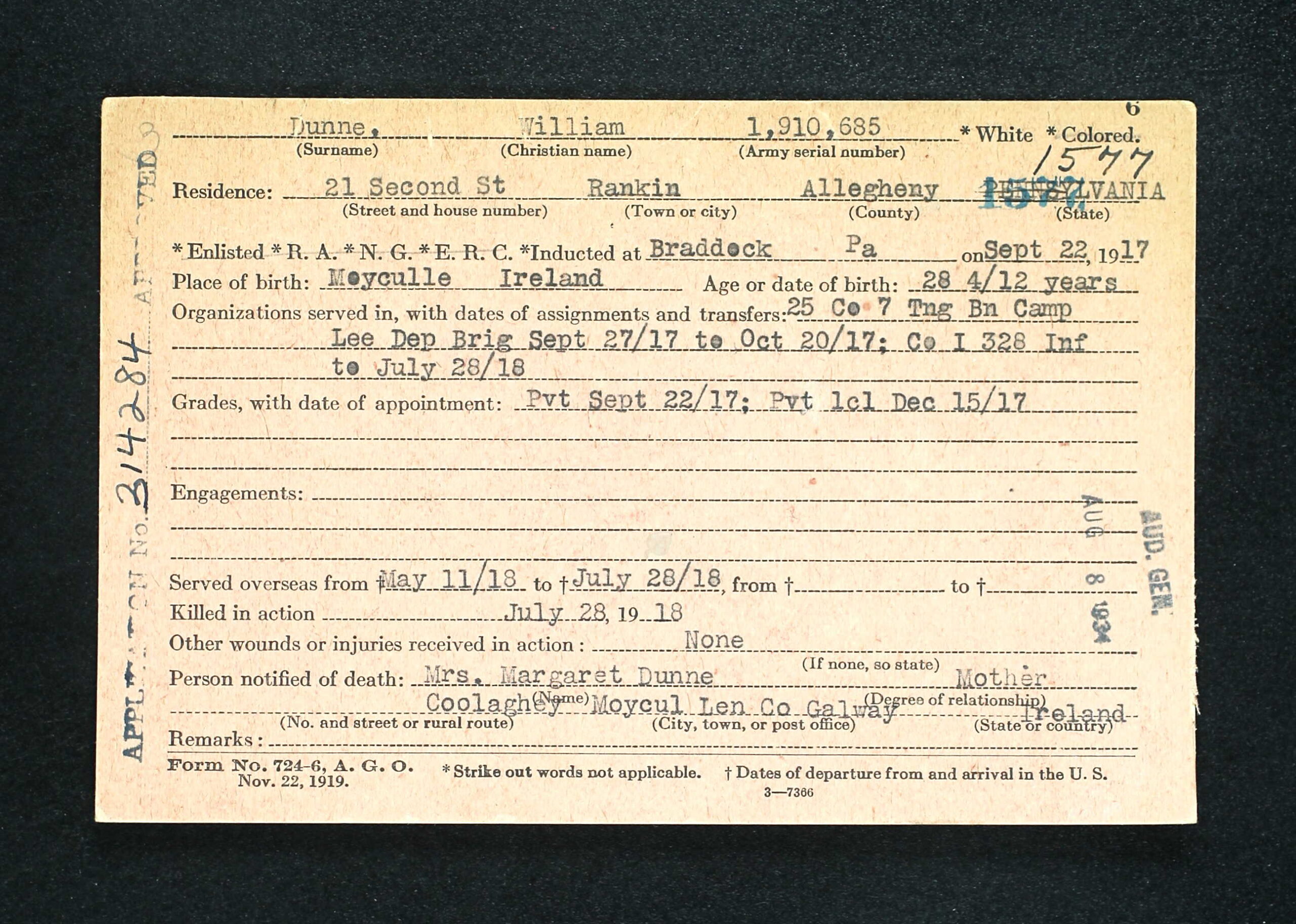
It was whilst in this employment, and unmarried, William enlisted in the US Army on 5 June 1917. His induction took place on 22 September 1917 at Braddock, Pennsylvania, where he became Private William Dunne, Army Serial Number 1910685.
He undertook military training with Company 25, 7th Training Battalion at Camp Lee, Virginia, between 27 September 1917 and 20 October 1917. He was then transferred to Company I, Casual Detachment, 328th Regiment Infantry, 82nd Division at Camp Gordon, Chamblee, Georgia.
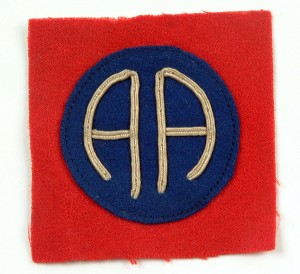
At the time, the 82nd Division’s draftees represented all 48 states, with many being immigrants or first-generation Americans. To help build camaraderie among these strangers from across the country, several new divisions began adopting nicknames. Brigadier General William P. Burnham, commander of the 82nd Division, held a contest to choose a name for his unit, inviting submissions from Atlanta residents. The winning suggestion, offered by Mrs. Vivienne Goodwyn, highlighted the historic fact that, for the first time, a U.S. division was made up of soldiers from every state in the Union. Her proposal, “All-American Division,” perfectly captured this spirit and inspired the troops to embellish their unit patches—originally a simple blue circle on a red square—with the white letters “AA.”
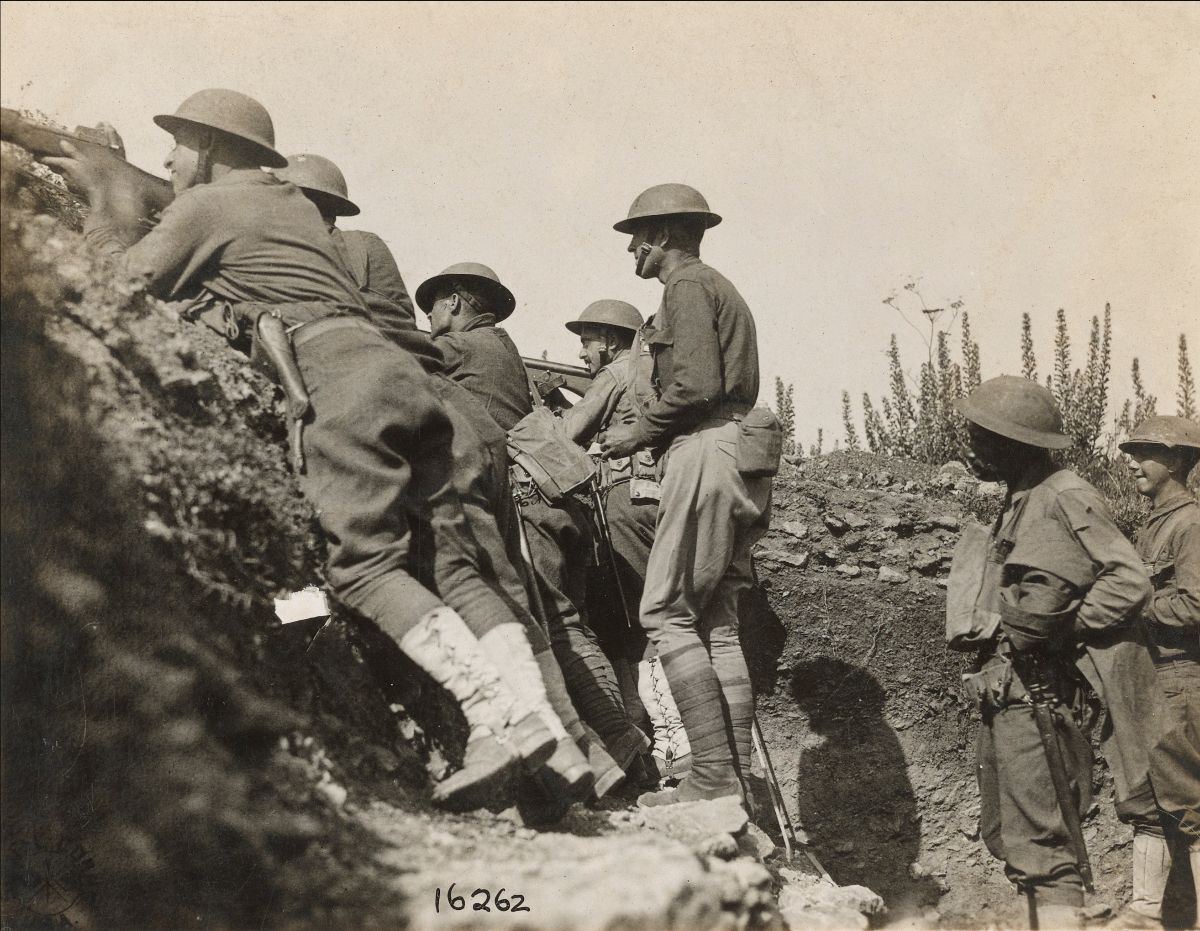
The 328th Infantry and the rest of the 82nd Division completed their training during the winter of 1917-1918, including instruction from British and French soldiers who were veterans of front-line combat against the Germans. Instruction would have included skills in auto rifle, hand grenade, rifle grenade, bayonet, gas defence and sniping. During this time, William received a promotion to 1st Class Private (15 December 1917).
In April, the division was accepted into federal service and units given entrainment orders.
“Beginning several days prior to our departure, relatives and friends flocked to the Camp in all kinds of conveyances for farewells. Our hike down to the railroad yards at Chamblee, Georgia, was made wearing overcoats and heavy woollen underwear and the biggest packs in captivity on a hot April day and with an inner feeling of martyrism, all of which conspired to concoct emotions which still linger in our memories. A motley crew of S. C. D., Depot Brigade men, tear-stained wives, mothers, sisters, sweethearts and others of varying relationship, waved us and embraced us till the old troop train pulled out”. Extract from History of Three hundred and twenty eighth regiment of Infantry : Eighty-Second Division, American Expeditionary Forces United States Army
The division travelled to Camp Upton, Long Island in standard pullman trains, with the men complaining as they had to sleep two to a berth! Upton was a camp created in 1917 to house troops and provide final training and preparation, as the forces awaited ships for deployment overseas to France. The regiment arrived at Upton by sections from 21-24th April inclusive. We haven’t been able to source rail records so don’t know which date exactly William arrived.
Upton was a camp made famous by AWOLs (Absent Without Leave).
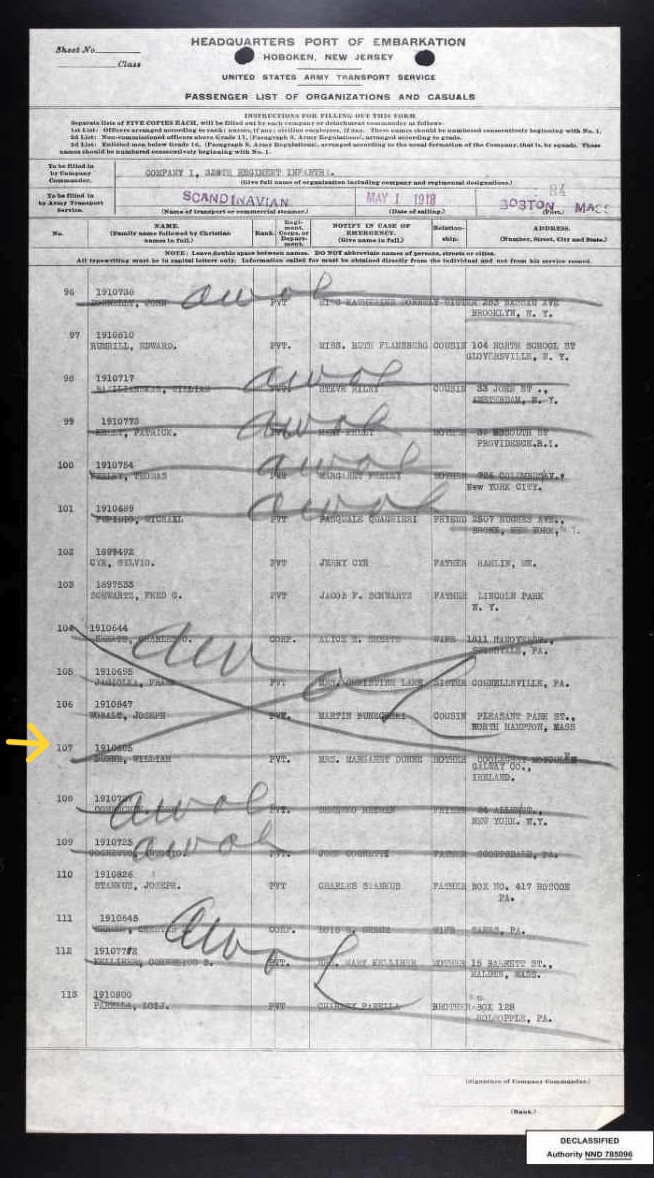
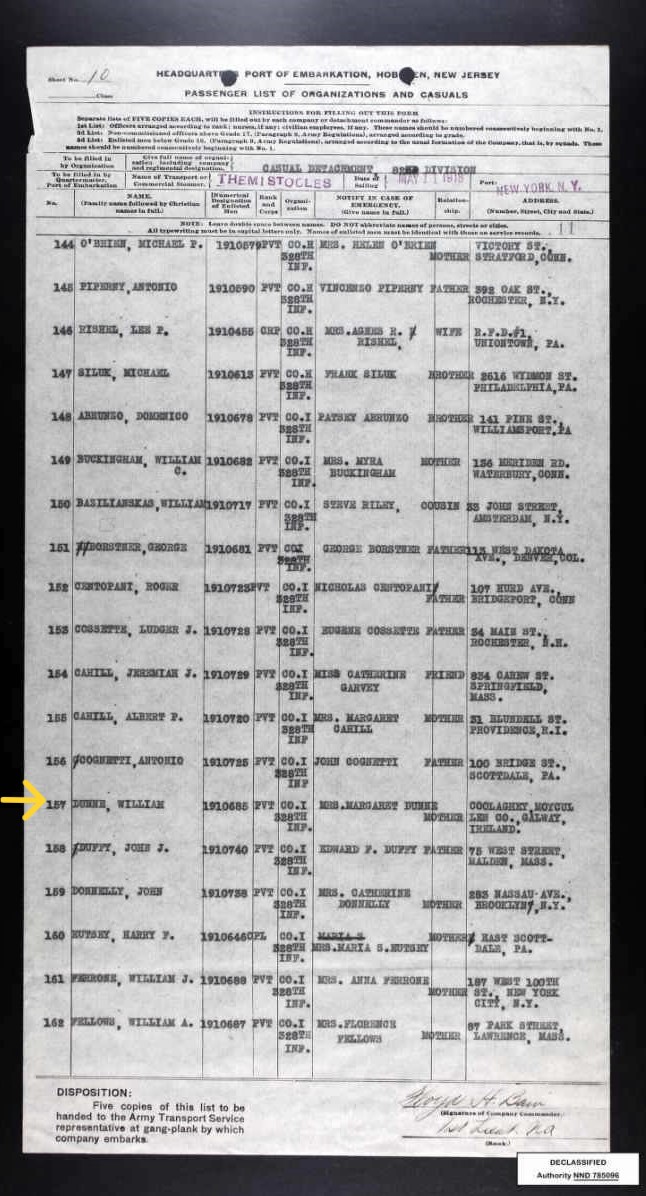
In late April, units travelled by train to Boston, where they boarded ships including HMS Grampian and HMS Scandinavian. The ships then sailed to New York City, where a convoy was assembled for an Atlantic crossing to England. William was absent without leave when he was scheduled to depart on 1 May 1918, so HMS Scandinavian, the ship he was assigned to, sailed without him. He eventually left New York on 11 May 1918 aboard HMS Themistocles.
After arriving in Liverpool, the 82nd Division boarded trains for the trip across England, then boarded ships at Southampton for cross-channel voyage to Le Harve, France.
After arriving in France, the 328th Infantry moved to positions near Horcelaines and nearby towns, where they prepared to go into combat as part of a larger American force that augmented British troops in the area. The 82d Division proceeded to the St. Valery-sur-Somme training area. Here it trained with the British 66th Division until 15 June 1918.
On June 15 the division moved to the area of the French Eighth Army in the vicinity of Toul, where the detached units, except the artillery, rejoined. Toul is between Commercy and Nancy, and the river Moselle and Canal de la Marne au Rhin.
They were assigned to the French XXXII Corps on June 22, and two days later moved to the Woëvre front. From June 25 to July 17 the division, less artillery, was affiliated with the French 154th Division, and participated in the occupation of the Lagney Sector on the south face of the St. Mihiel salient. On July 18 the sector was reduced in extent, redesignated the Lucey Sector, and command given to the 82d Division.
DEATH & BURIAL
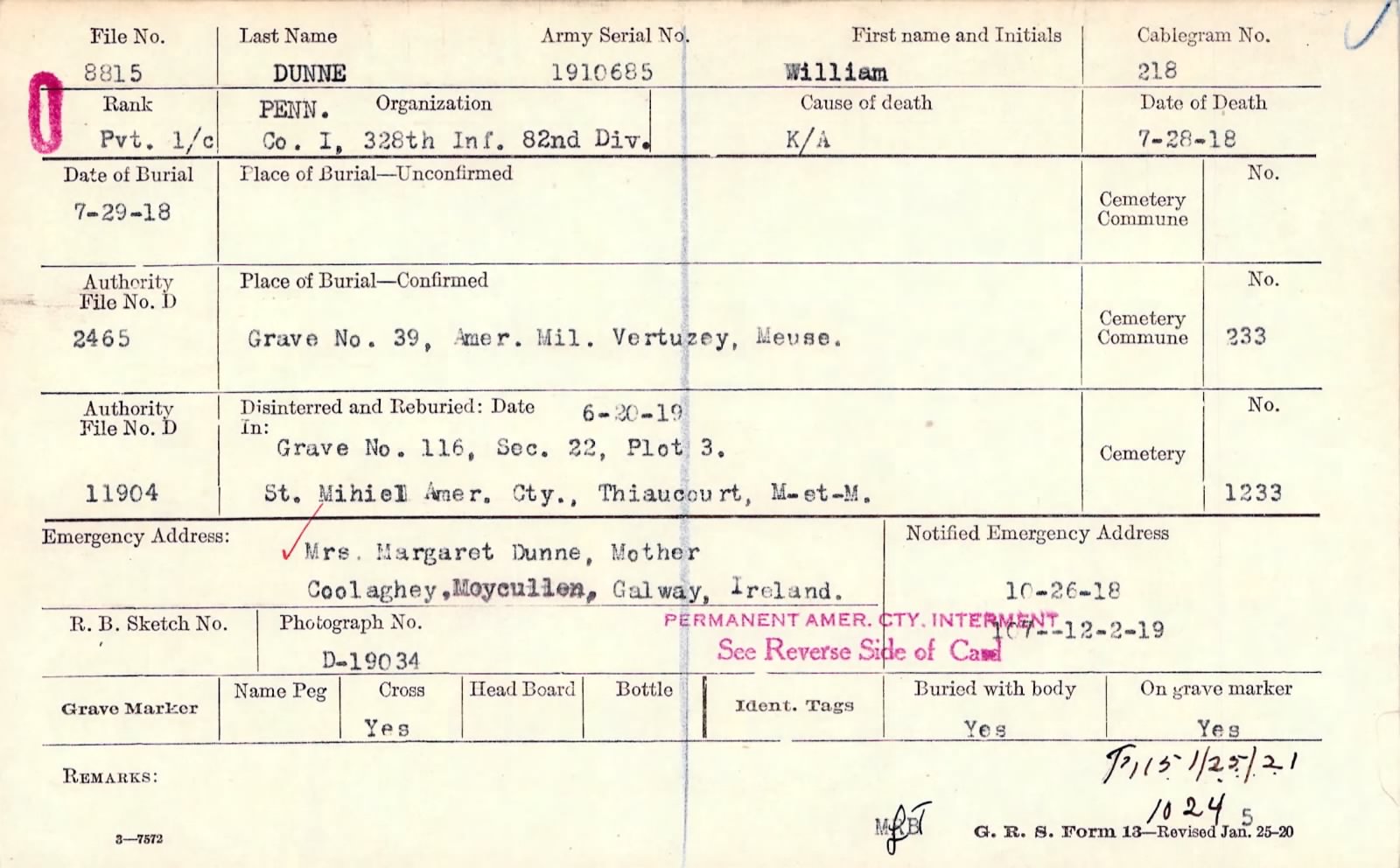
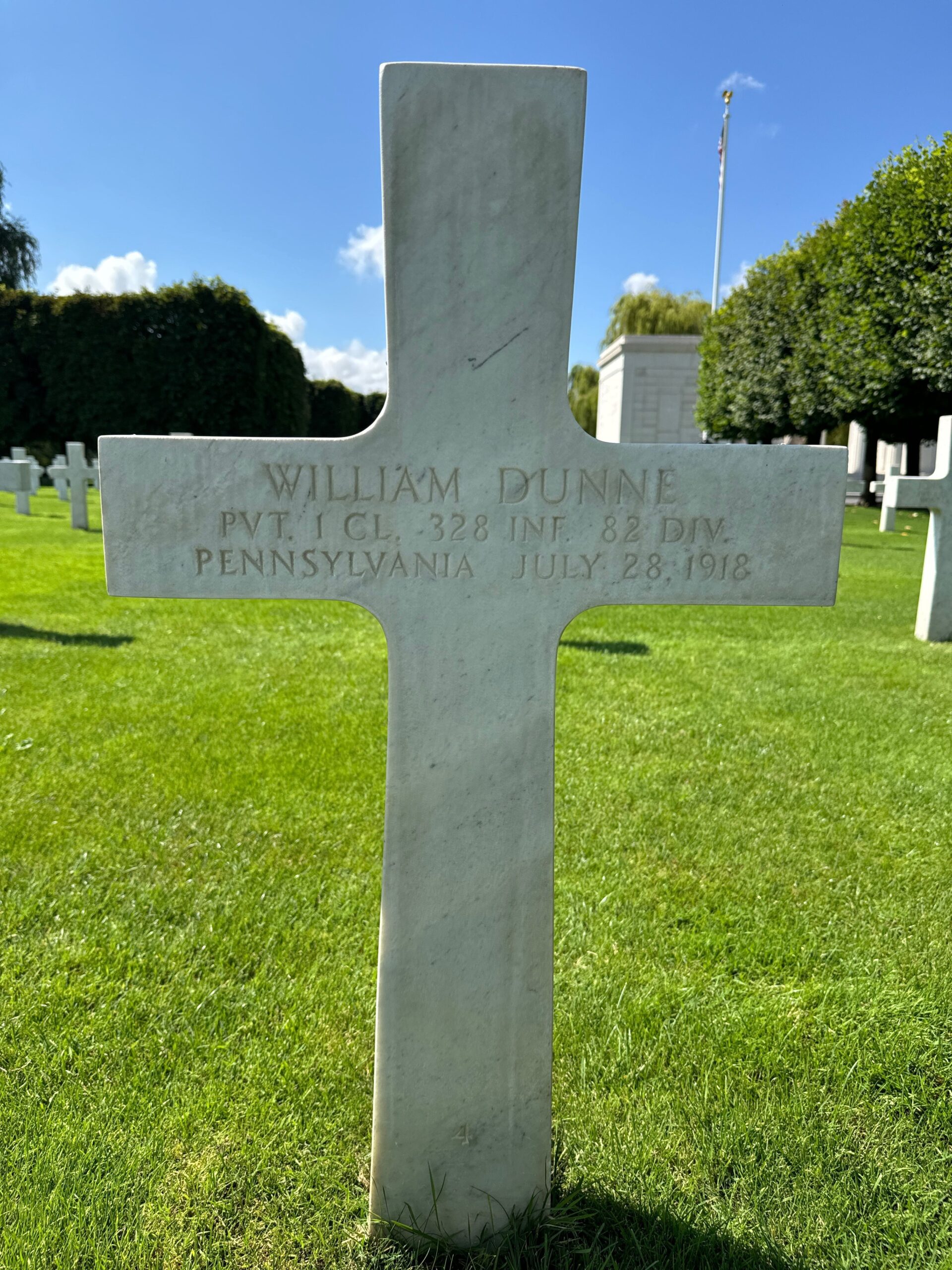
Before the division were relieved by the 89th Division on 10 August 1918, William had been killed in action along the front line at Bouconville. There are conflicting dates given for his death – the History of Three Hundred and Twenty Eighth Regiment of Infantry Eighty-Second Division American Expeditionary Forces United States Army, note his date of death as 8 August 1918 but his headstone gives 28 July 1918, which is the correct date.
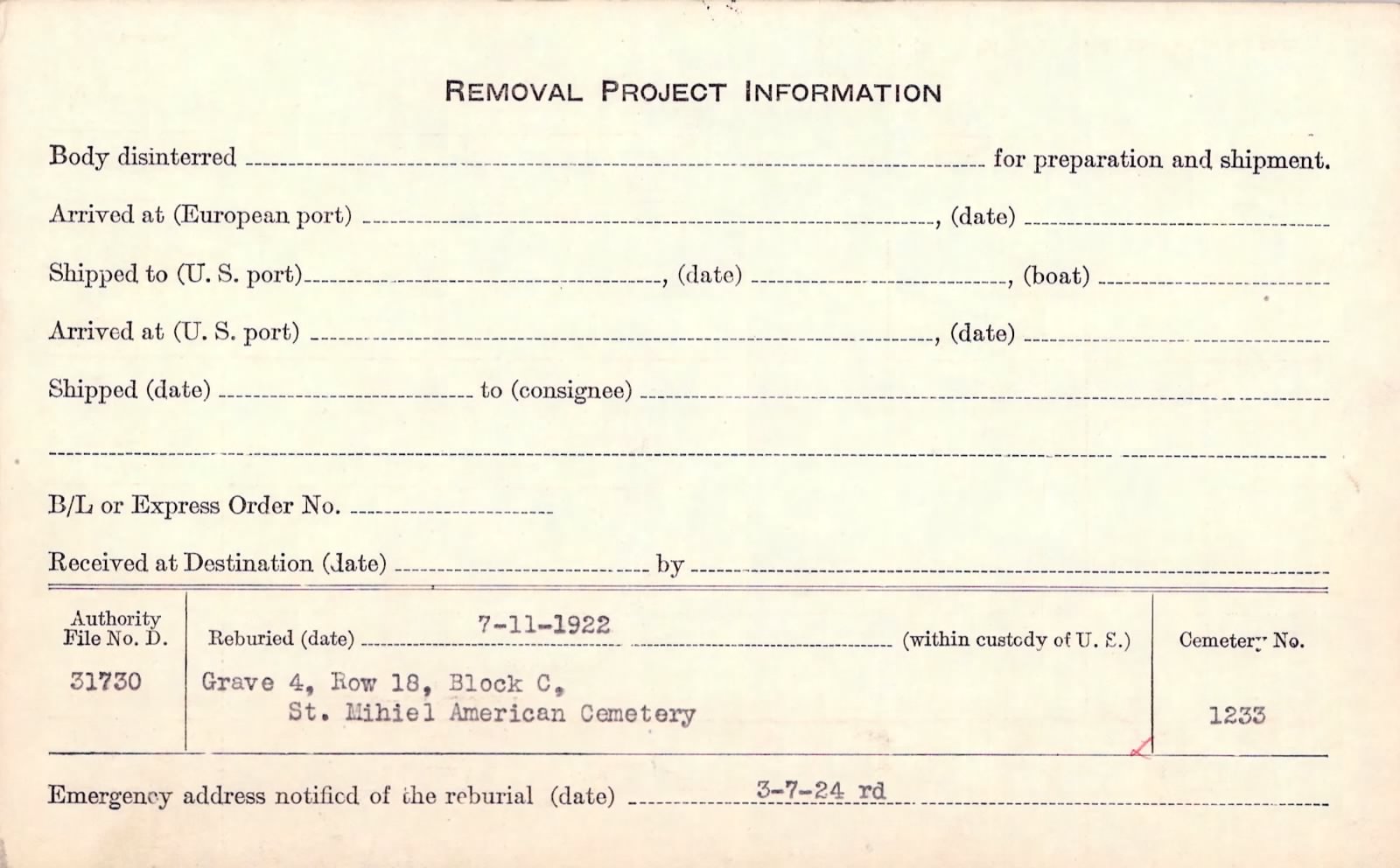
William was initially laid to rest on 29 July 1918 in Grave No 39, American Military Cemetery, Vertuzey, Meuse, France. On 7 November 1922 he was disinterred and his body reburied in Plot C, Row 18, Grave 4 in the Saint-Mihiel American Cemetery and Memorial, located in Thiaucourt-Rognieville, Meurthe-et-Moselle, Lorraine, France. Soldiers were reburied in the St. Mihiel American Cemetery from temporary burial sites, including Vertuzey, because the United States wanted to consolidate the dead into permanent cemeteries, a process to honor the soldiers’ sacrifices and bring unity to their final resting place. Saint-Mihiel is the third-largest World War I American cemetery in France, holding the graves of 4,153 American military dead from the St. Mihiel Offensive.
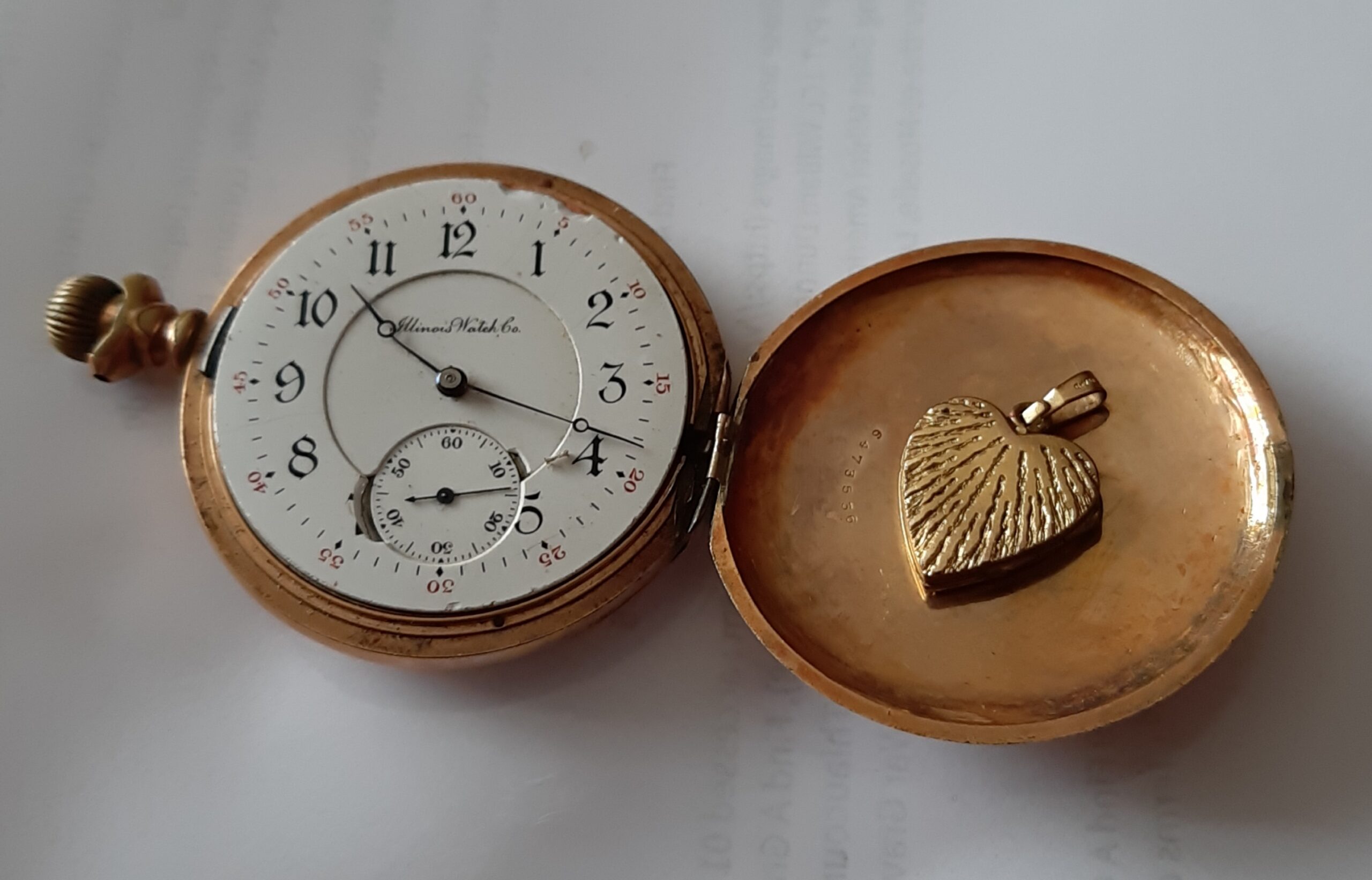
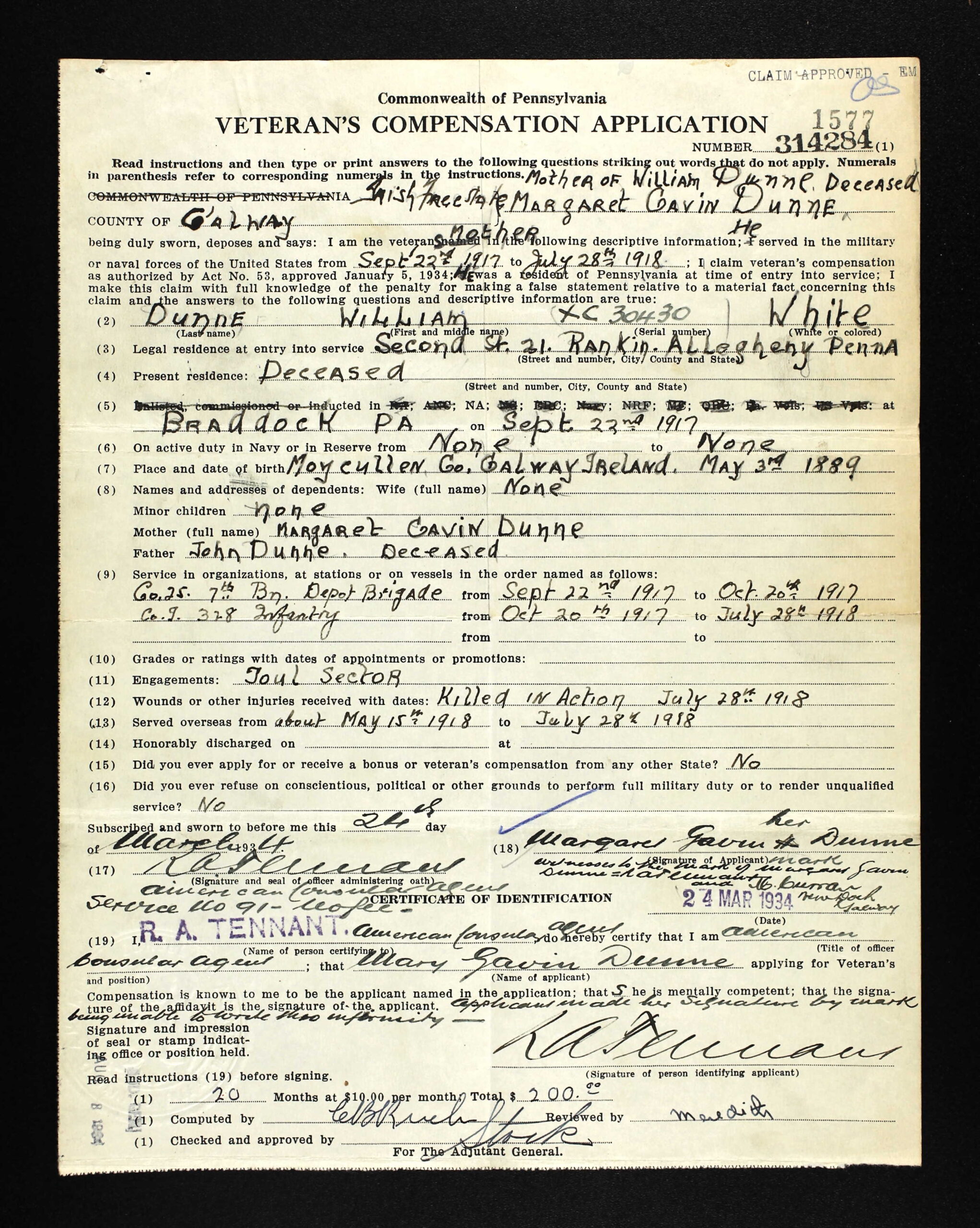
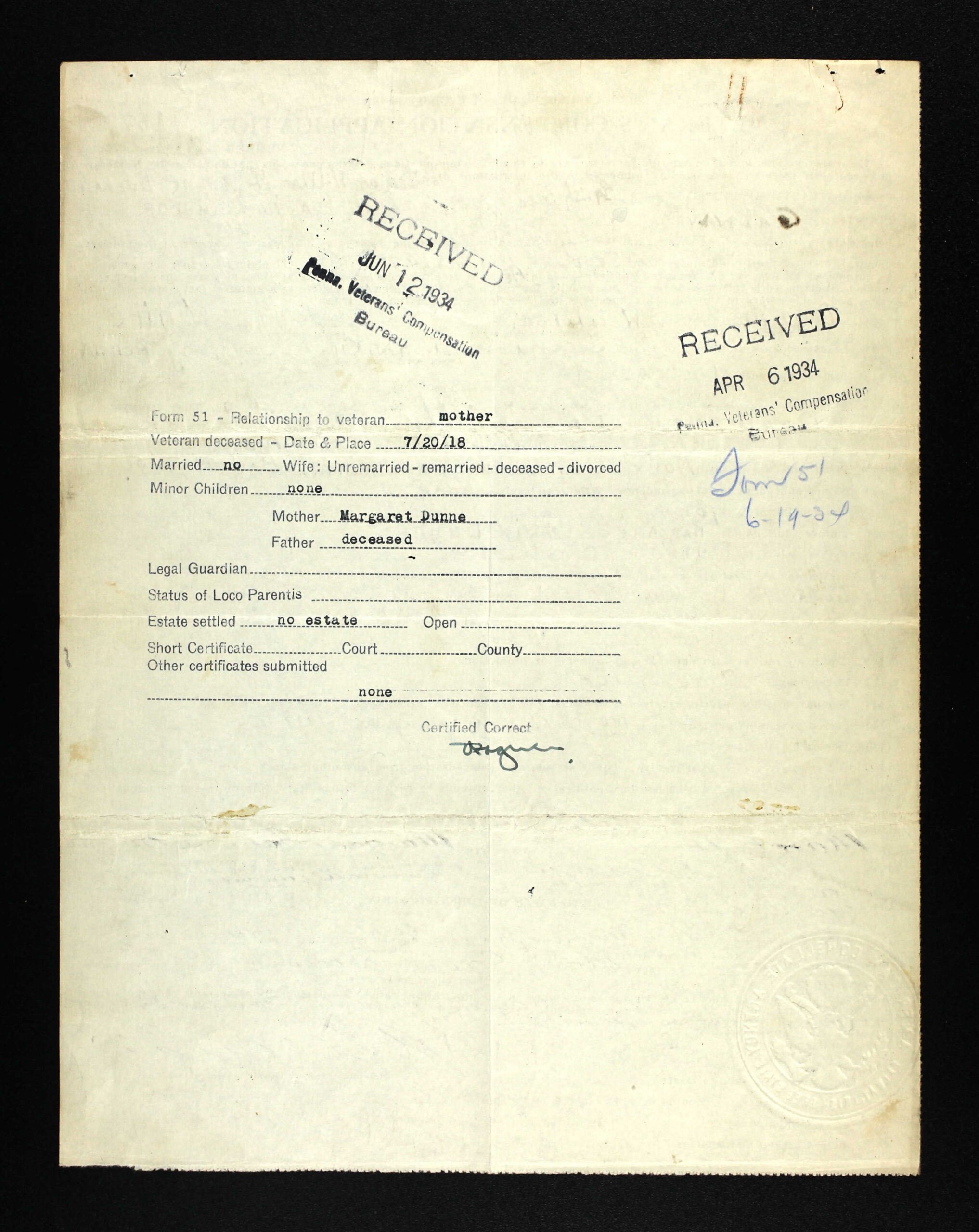
News of William’s death was sent to his next of kin—his mother in Coolaghy, Moycullen—along with his few personal effects, which included a pocket watch that remains a cherished possession of his grandniece today. In 1934, his mother submitted a Veterans Compensation application (No. 314284) and was awarded $10 per month for 20 months, amounting to a total of $200 (the equivalent of approx. €4,140 in todays money). This sum serves as a poignant reminder of the profound financial and emotional burdens carried by families who gave so much during the Great War.
We would like to express our sincere gratitude to Margaret Barrett and Martin Barrett for their generous assistance in researching the life and military career of their ancestor, William Dunne.
Although no known photograph of William survives, we hope that this acknowledgment of his life and bravery helps to keep his memory alive.
References & Sources:
US Army Centre of Military History
https://history.army.mil
History of Three Hundred and Twenty Eighth Regiment of Infantry Eighty-Second Division
American Expeditionary Forces United States Army
http://www.rareflags.com/references/History_of_the_328th_Infantry_Regiment.pdf
Jonathan D. Bratten, ‘To the Last Man, A National Guard Regiment in the Great War, 1917-1919‘
https://www.armyupress.army.mil/Portals/7/combat-studies-institute/csi-books/to-the-last-man.pdf
Divisional Officers Designated by the Division Commander, ‘Official History of 82nd Division American Expeditionary Forces, 1917-1919‘
https://www.survivorlibrary.com/library/official_history_of_82nd_division_1920.pdf
https://uk.forceswarrecords.com
No Comments
Add a comment about this page