
Thomas O'Malley of Ballinahallia (1882-1918)
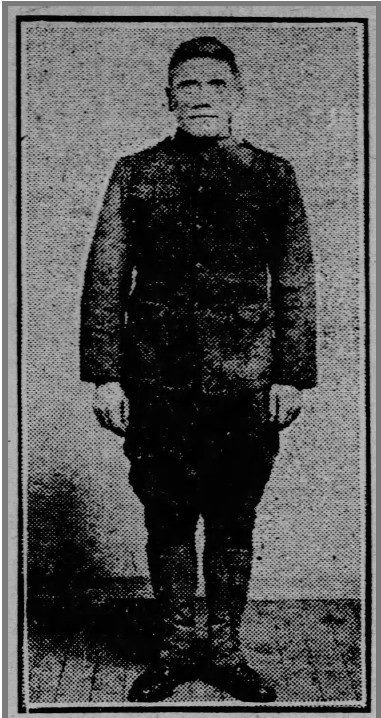
![Thomas O'Malley homestead 1901 Census – House 6 [Leggaun] Moycullen | www.nationalarchives.ie](https://dpdgay9x1sxad.cloudfront.net/wp-content/uploads/sites/15/2024/08/1901-Census-Family-of-Patt-Malley-Leagaun.jpg "1901 Census Family of Patt Malley Leagaun")

EARLY YEARS IN IRELAND
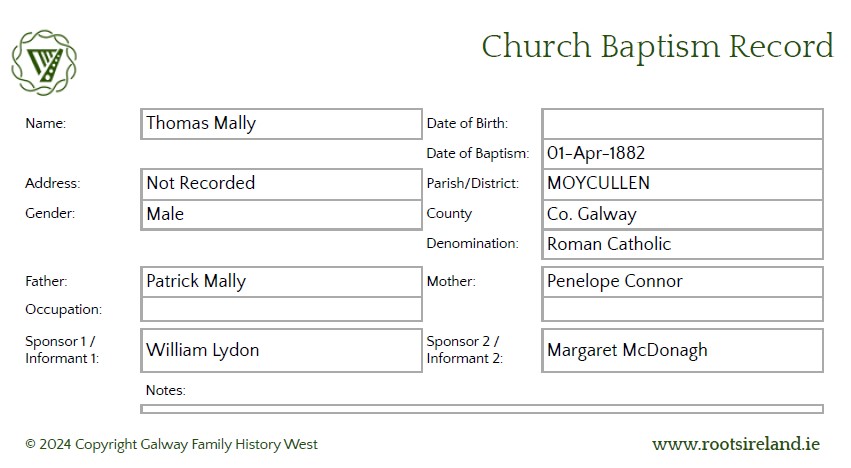
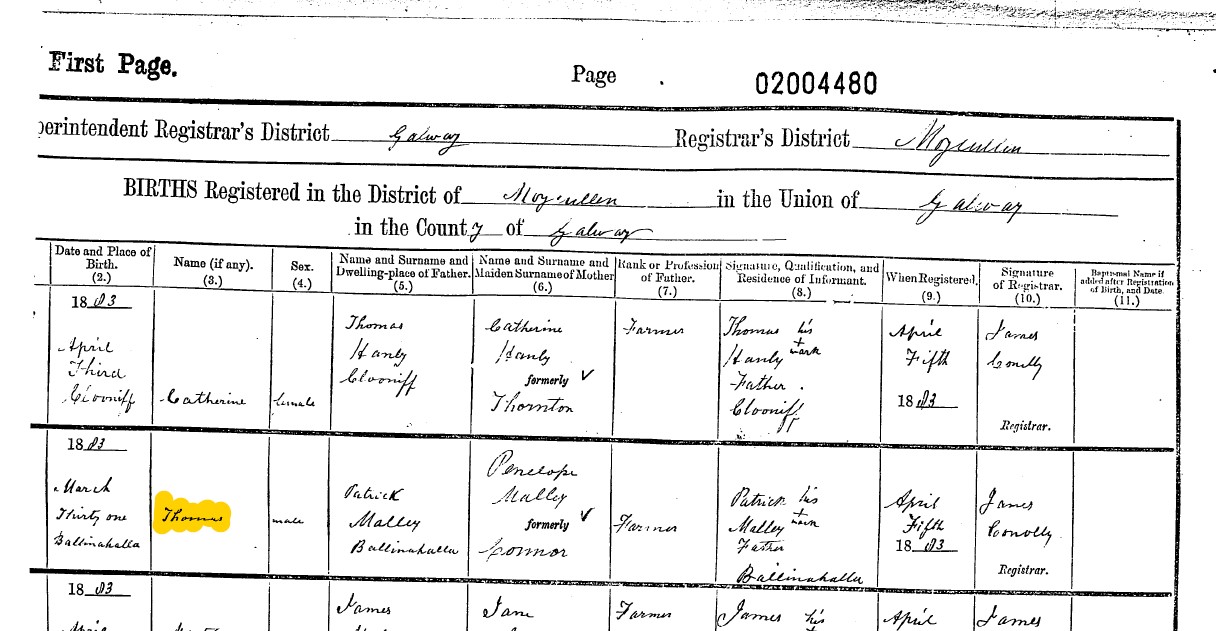
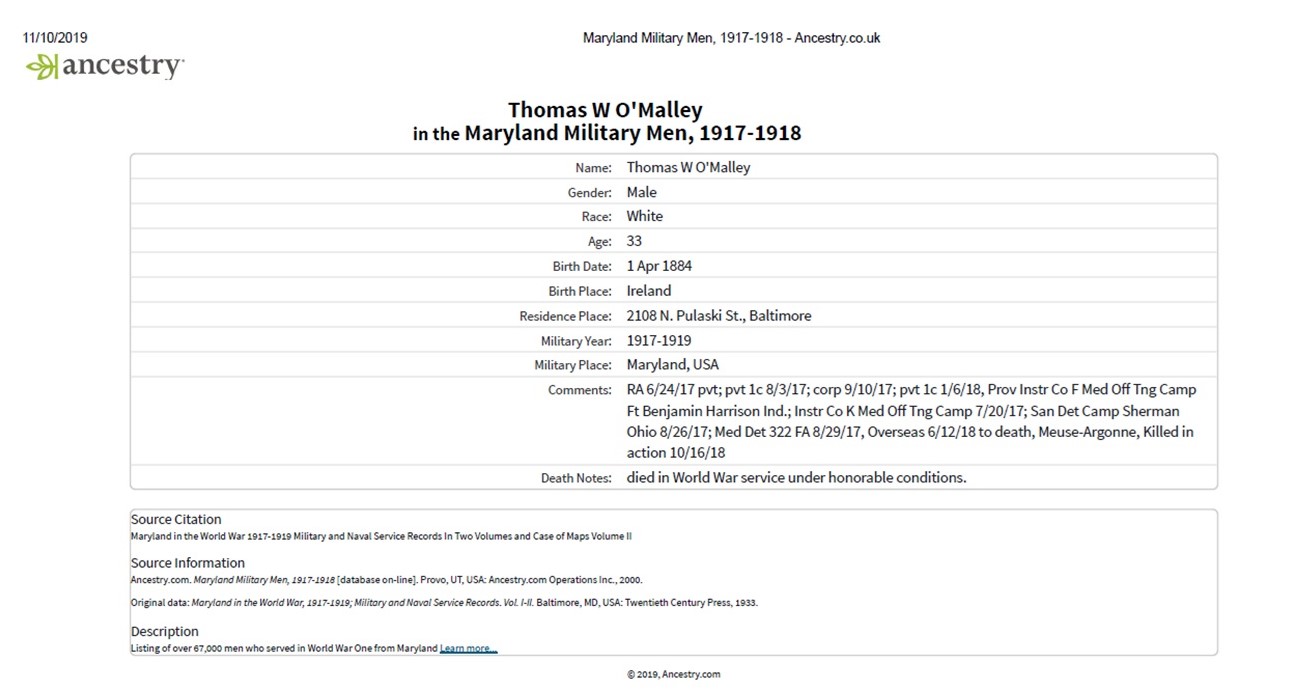
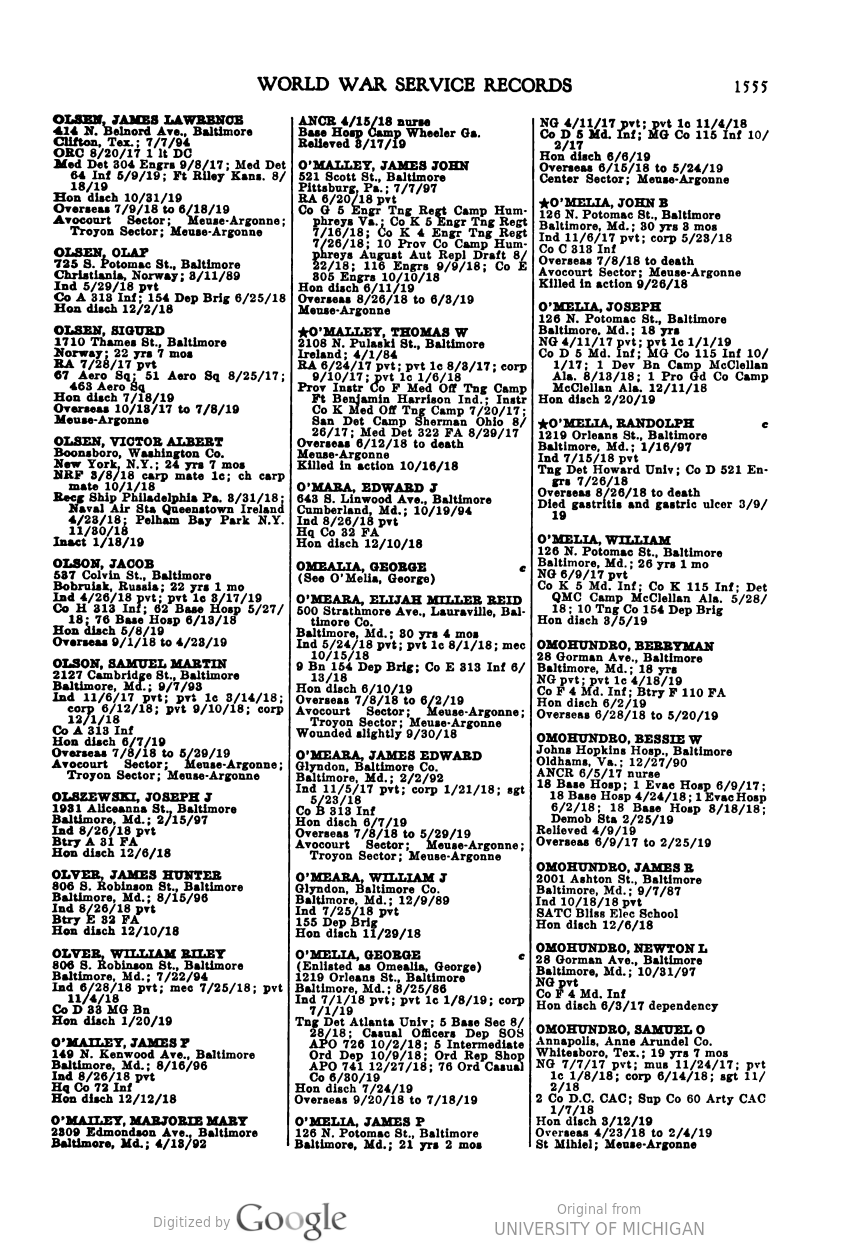
THOMAS MALL[E]Y was born to Patrick Malley and Penelope (Nappy) O’Connor and was baptised in Moycullen church on 1 April 1882. His sponsors were William Lydon and Margaret McDonagh. The date given on the baptism transcription may have been an error by a year as Thomas Malley’s civil birth record gives his birth date as 31 March 1883 at Ballinahalla, Moycullen. Thomas himself (on military records etc.) gives his date of birth as 1 April 1884!.
Thomas, an agricultural labourer, is noted on the 1901 census as living at home in Leagaun, Moycullen with four of his eight siblings Patrick (Patt), Charles, Catherine (Katie) and Bridget (Delia) and also his father, Patrick Malley. His brother Edmund (Edward) was already in USA and three siblings had died young, Mary, William and Joseph. His mother had passed away in 1899 just after the birth of his youngest brother.
EMIGRATION
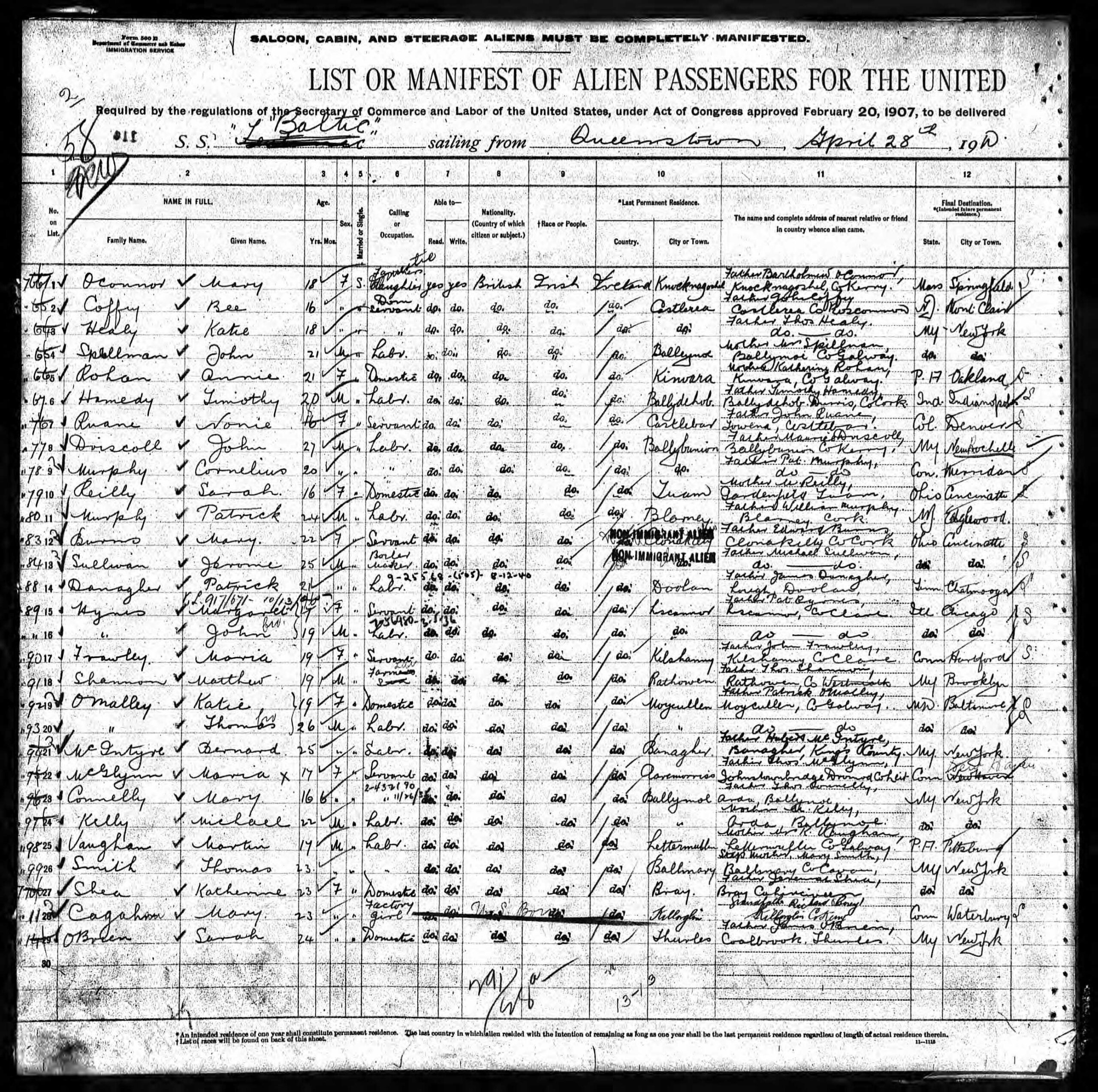
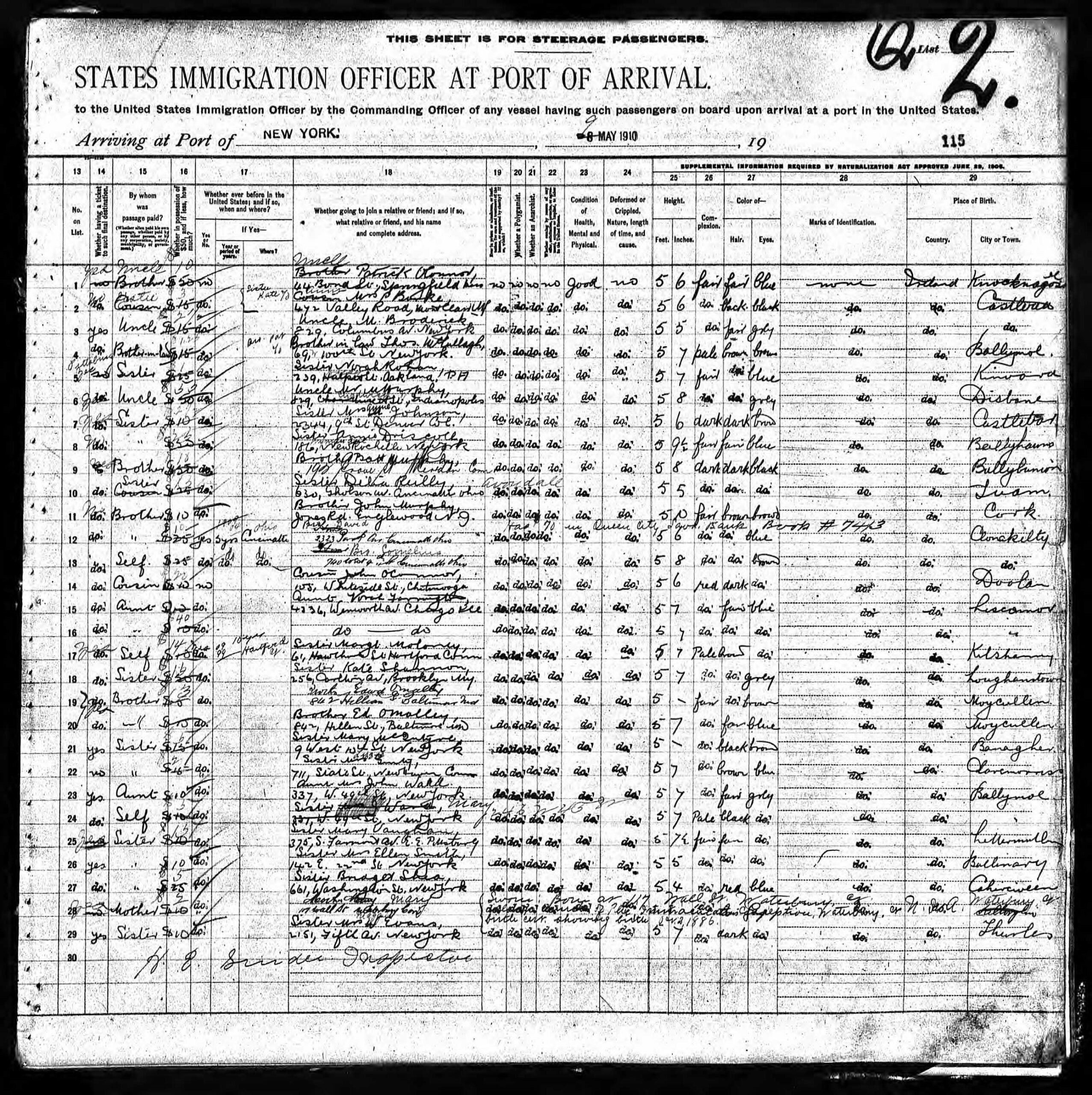
Together with his sister Katie, Thomas emigrated to USA, leaving the port of Queenstown (Cobh) Co Cork on board the SS Baltic on 28 April 1910. With $15 in his pocket, Thomas stood at 5ft 7in tall, fair hair, blue eyes and a fair complexion – his ticket had been paid for by his brother Edward who was at that stage residing at 842 Hillen Street, Baltimore (an address also of their uncle Edward O’Malley). The SS Baltic pulled into New York harbour on 9 May 1910 after nearly two weeks at sea.
Thomas’ time in America wasn’t recorded on any census. One had been carried out on 15 April 1910, a short time before his arrival, and the next wasn’t until 5 January 1920 which was after his death.
ARMY LIFE
Thomas O’Malley enlisted in the American National Army on 24 June 1917 as Private No. 1952792, beginning provisional medical officer training with Company F at Fort Benjamin Harrison, located in suburban Lawrence Township, Marion County, Indiana, northeast of Indianapolis.
He continued his training with Company K from 20 July 1917, and on 3 August 1917 he was promoted to Private First Class.
On 26 August 1917, Thomas was transferred to Camp Sherman, Ohio, where new recruits learned the essentials of military life. The men trained on artillery pieces, studied ballistic trajectories, and practiced firing in the hills south of Chillicothe. Thomas may even have assisted in the construction of the camp’s 1,300 buildings, erected by the Army between June and September 1917. Camp Sherman’s hospital played a crucial role in the care of wounded soldiers and served as a training ground for the treatment of battlefield injuries. Here Thomas may have learned specialized methods such as the Carel-Dakin method of medically removing debris and dead or infected tissue from battle wounds.
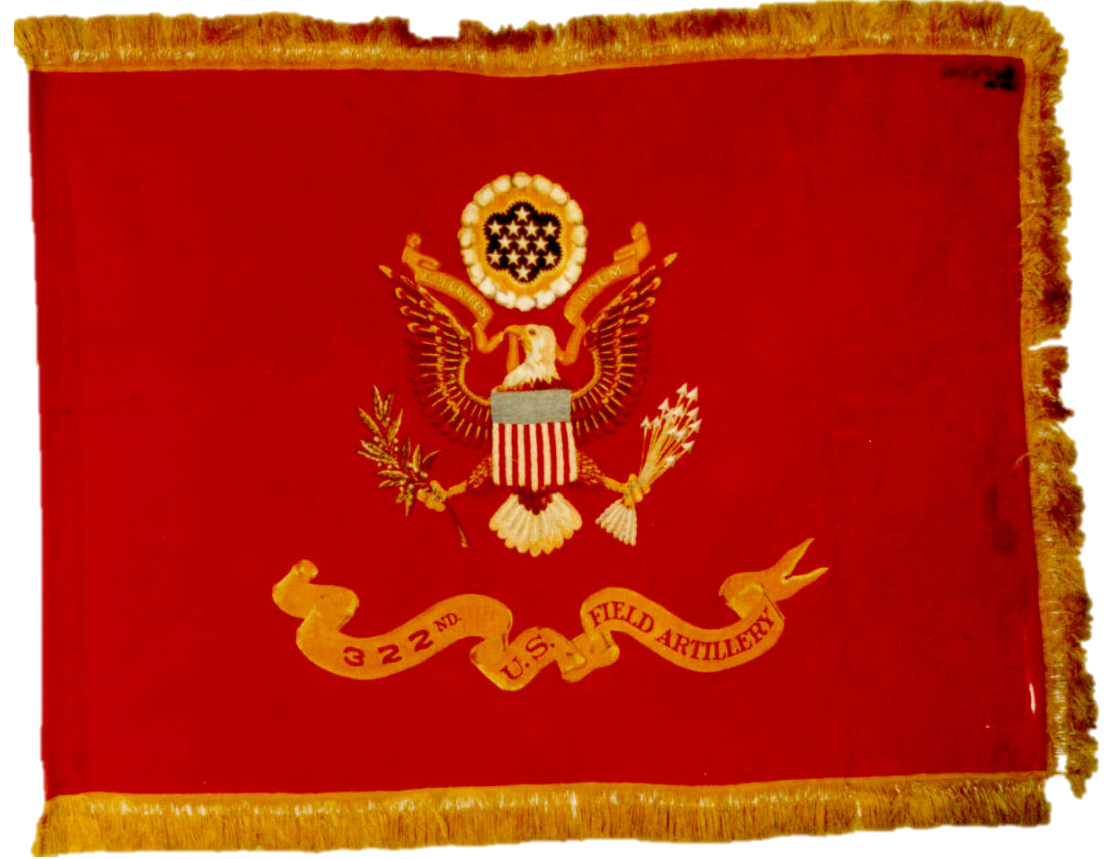
On 29 August 1917, he was attached to the 322nd Field Artillery, Medical Detachment, 83rd division – sometimes referred to as the “Ohio” or ‘Sherman Bayonet’ division. Less than two weeks later, on 10 September 1917, he was promoted to Corporal, but reverted to Private First Class on 6 January 1918 for reasons not recorded.
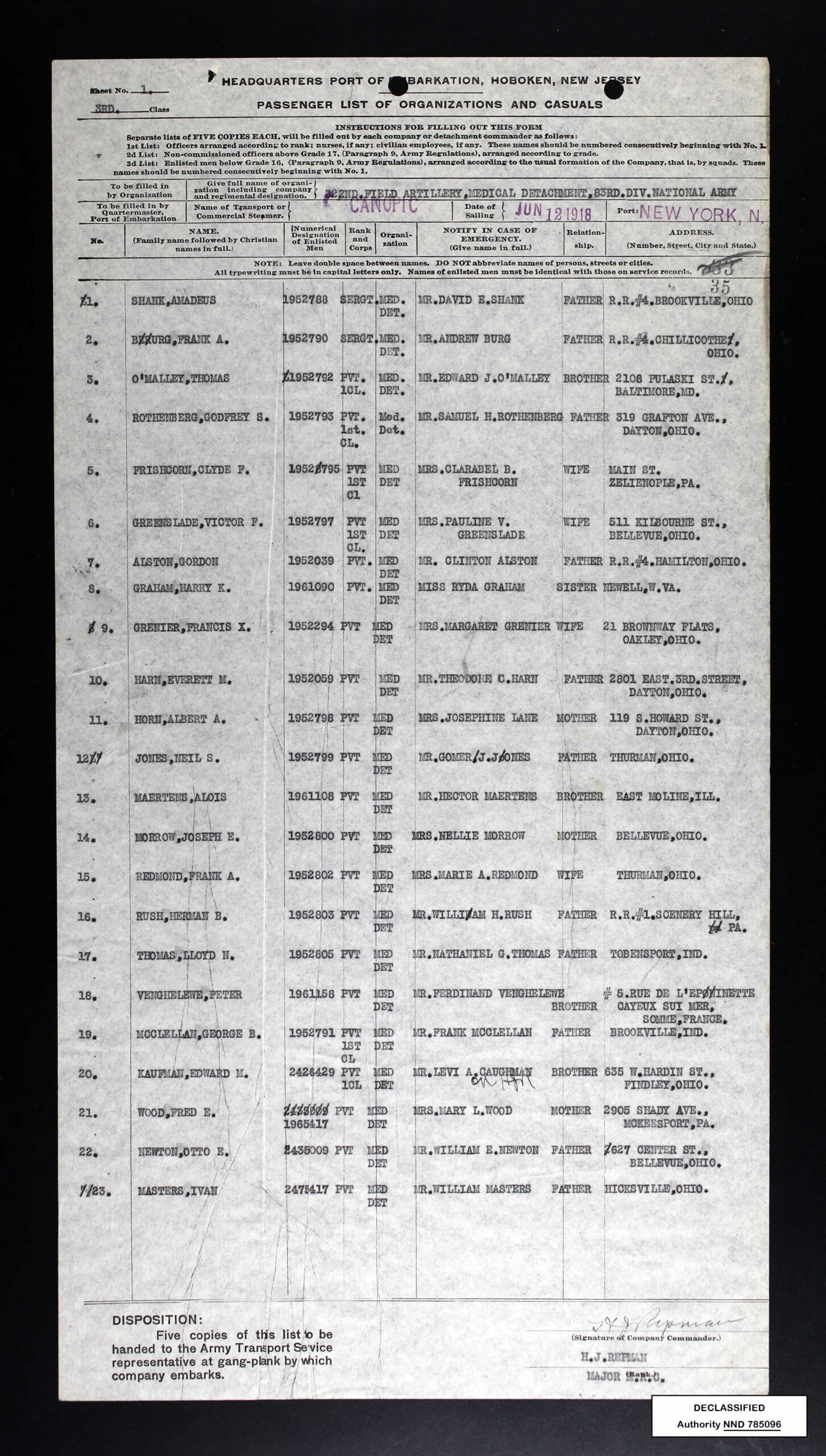
On 12 June 1918, Thomas sailed from the Port of New York aboard the Canopic. His service record lists his next of kin as his brother, Edward J. O’Malley, of 2108 Pulaski Street, Baltimore. Theirs was a timely exedous from Camp Sherman, as by October newspapers were reporting the spread of influenza or Spanish flu at the site – approximately 5,686 cases were documented among Camp Sherman soldiers in 1918, 1,777 of them were unable to ward off the disease and died.
The 83rd Division traveled to France together, but upon arrival, General John J. Pershing of the American Expeditionary Forces reorganized the division, distributing its units to reinforce others. The 322nd Field Artillery remained intact and continued its combat artillery role while being attached to different divisions as needed.
In France, their training intensified, and by September 1918, the 322nd was ready for combat on the Western Front. That month, General Pershing assembled his divisions into a field army for a major offensive — the Meuse-Argonne Offensive. On 26 September 1918, the 322nd Field Artillery, attached to the 32nd Division in support of the 37th, 79th, and 91st Divisions, opened fire on German positions near Montfaucon. The artillerymen remained engaged in the Montfaucon sector until October 3, when they received orders to relocate. After a brief period of rest and resupply, the 322nd returned to action, continuing its support of U.S. troops advancing through the Meuse-Argonne.
Within this theatre of war, Thomas’ role with the 322nd Field Artillery Medical Detachment, would likely see him having to carry out such harrowing roles as assisting the movement of injured soldiers from the front lines under extremely difficult terrain and combat conditions. He would have had to treat battlefield injuries, stabilize casualties, help establish and operate aid stations to care for the wounded before evacuation, and work alongside chaplains to offer spiritual care and morale support to the troops enduring the harsh realities of the front. Not a job for the faint hearted.
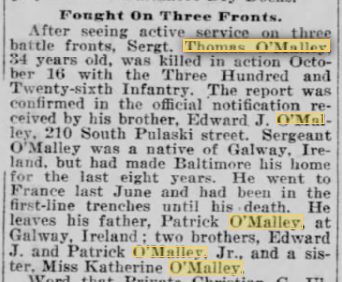
On the morning of 16 October 1918, as he ate breakfast, Thomas O’Malley was struck down and killed in action. His death came during the closing days of the Meuse-Argonne Offensive, one of the war’s bloodiest campaigns—just shy of the peace that would come with the Armistice on 11 November 1918.
The letter, written by Lt. Gail K. Butt, to Thomas’ brother Edward J O’Malley is as follows;
With regret and sorrow I announce the sudden death of Thomas O’Malley at 6.30 a.m., October 16, while he and a comrade from my medical detachment were eating breakfast, near our kitchen. He and three others never knew anything ever happened. He is buried at this place and the spot marked. He was a good soldier, fought a good fight and I know gladly gave his blood for democracy.
The letter was written October 17 at the front in France.
A requiem high mass was held for Thomas in St Gregory’s Church in Baltimore at 8.30am on Tuesday, 23 November 1918.
BURIAL
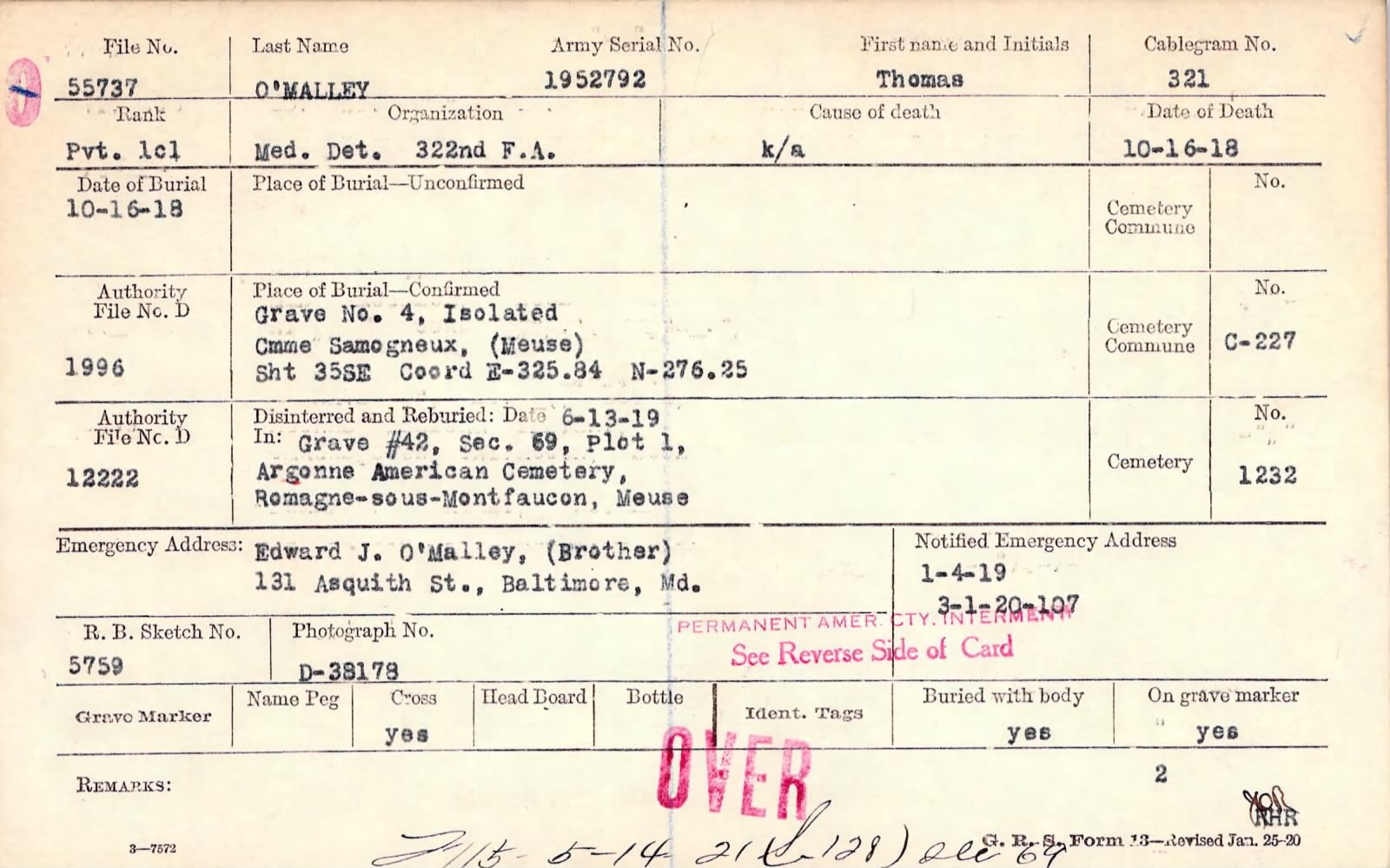
Thomas’ remains were initially buried in an isolated grave number 4 in Samogneux, a commune in the Meuse department in Grand Est area of north eastern France. The co-ordinates for the grave were E-325.84 N-276.25. On 13 June 1919 his remains were disinterred by the US National Army and reburied in Grave #42, Section 69, Plot 1 in Argonne American Cemetery, Romagne-sous-Montfaucon, Meuse. His identity tags were buried with him and the grave marked with a cross.
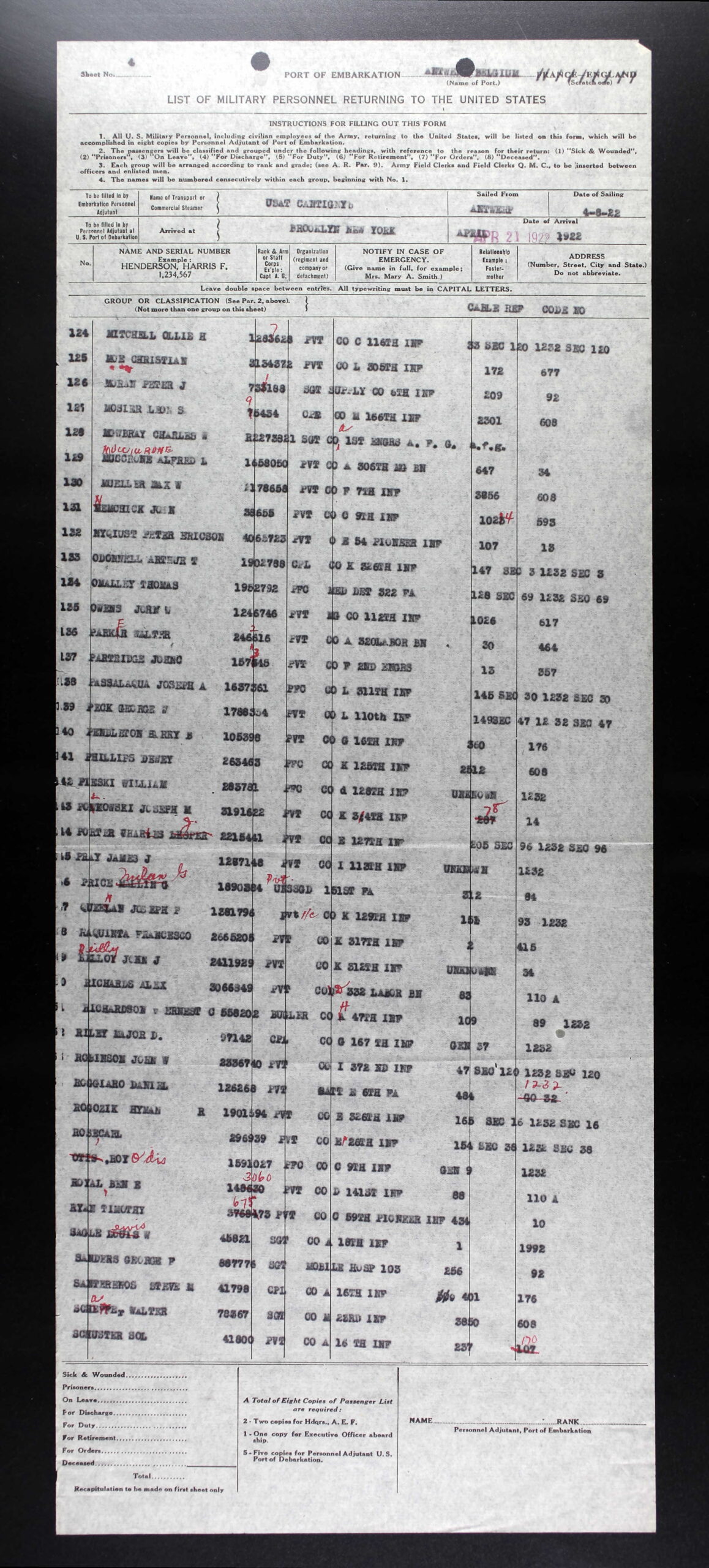
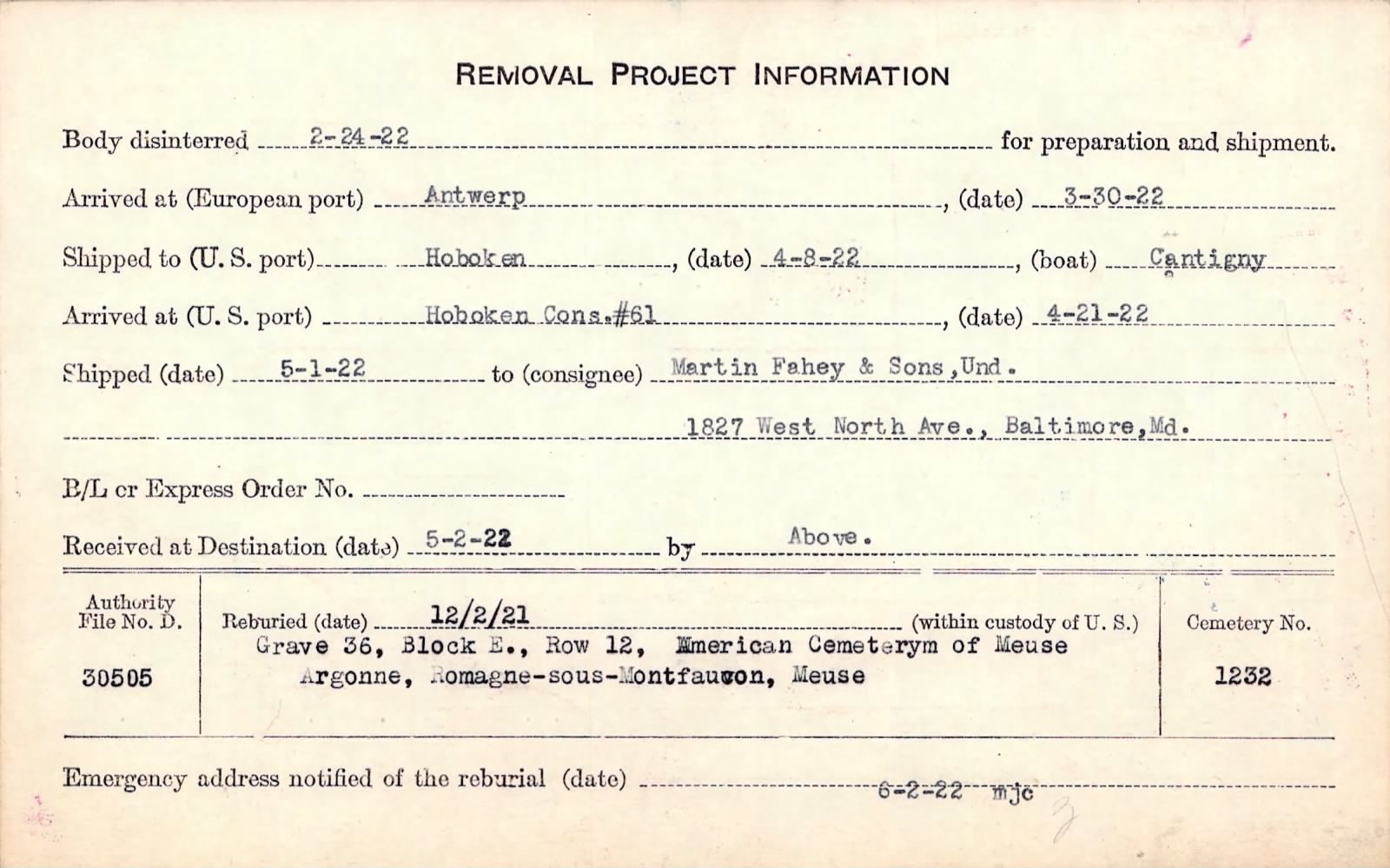
On 24 February 1922 his remains were again disinterred, this time to be returned to USA. They arrived at the port of Antwerp on 30 March 1922, and 8 days later, on board the USAT CANTIGNY, were repatriated to USA, arriving in Hoboken port, Brooklyn New York on 21 April. It took until the 2 May 1922 before Thomas’ remains were eventually received in Baltimore by Undertakers Martin Fahey, 1827 West North Avenue.
A post in the The Sun newspaper of Baltimore on 4 May 1922 reads
O’MALLEY — On October 16, 1918, KILLED IN ACTION in the World War, THOMAS J., son of Patrick and *Anabella O’Malley, native of County Galway, Ireland. Funeral from the residence of his sister, Mrs. Charles R. Donnelly, 2206 Clifton Avenue. Requiem High Mass at St. Gregory’s Church. Interment in New Cathedral Cemetery.
* Note incorrect name given for Thomas’ mother in newspaper article – it should have read Penelope not Anabella.
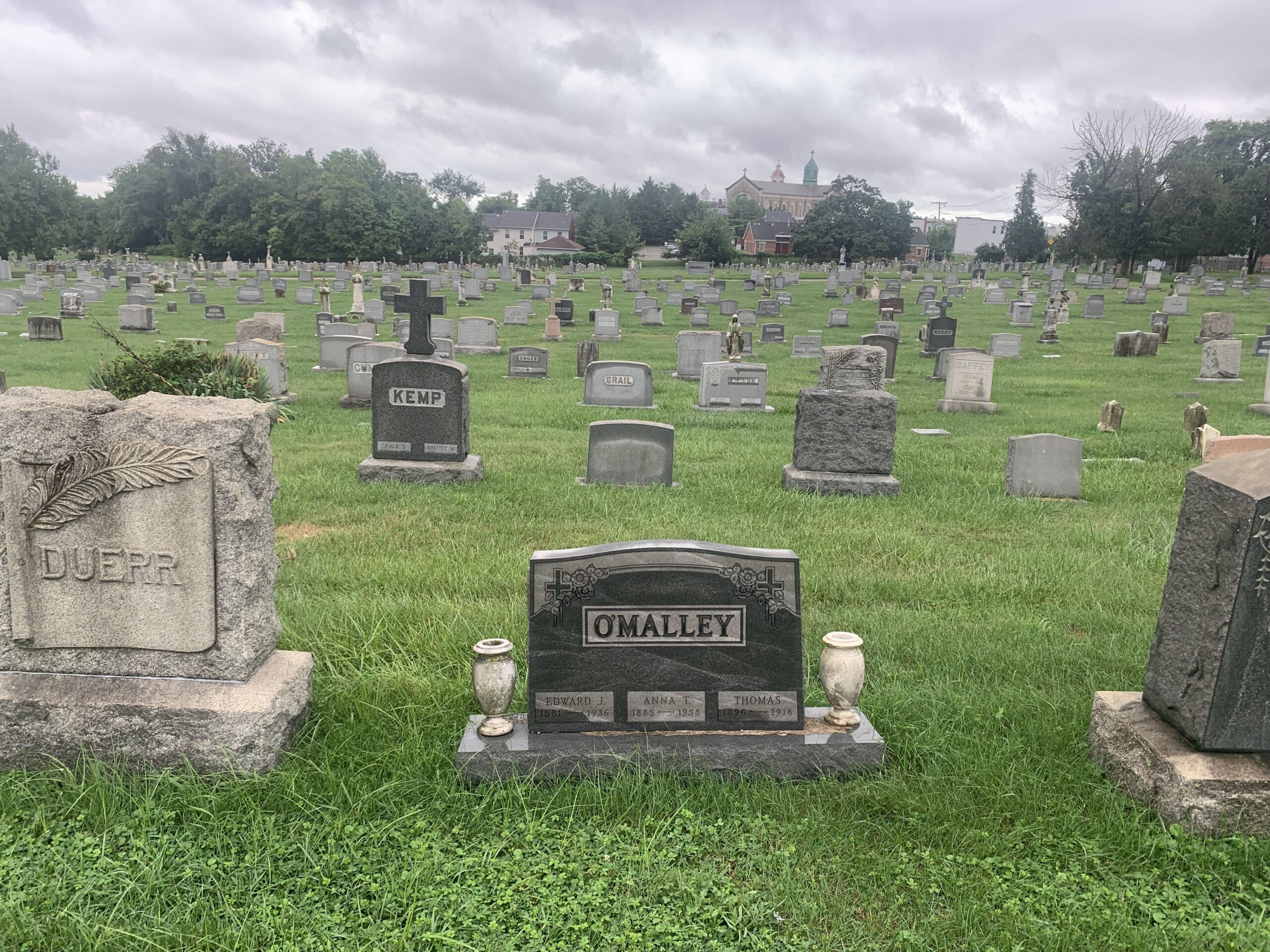
Thomas now lies with many other O’Malley family members in the New Cathedral Cemetery in Baltimore. His resting place is Section KK/Lot 189/Grave 3, a plot he shares with his brother Edward and sister-in-law Anna. His life history of incorrect birth years continued to his gravestone – it should read 1882 not 1896!
No Comments
Add a comment about this page