
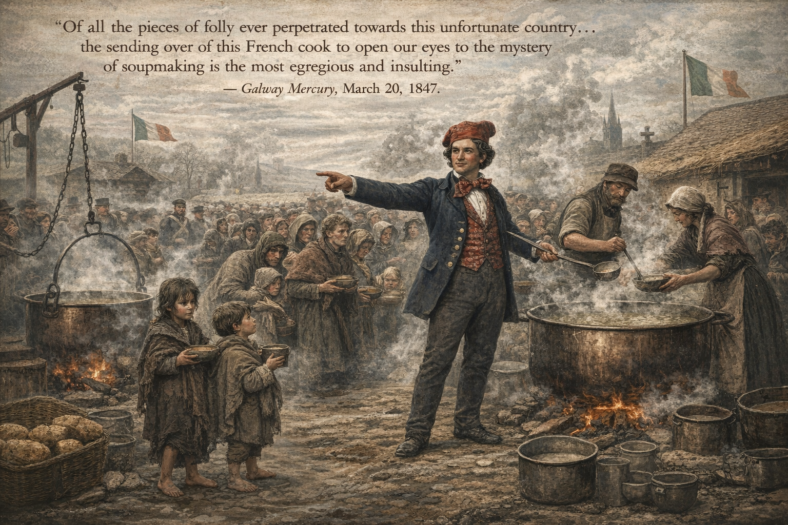
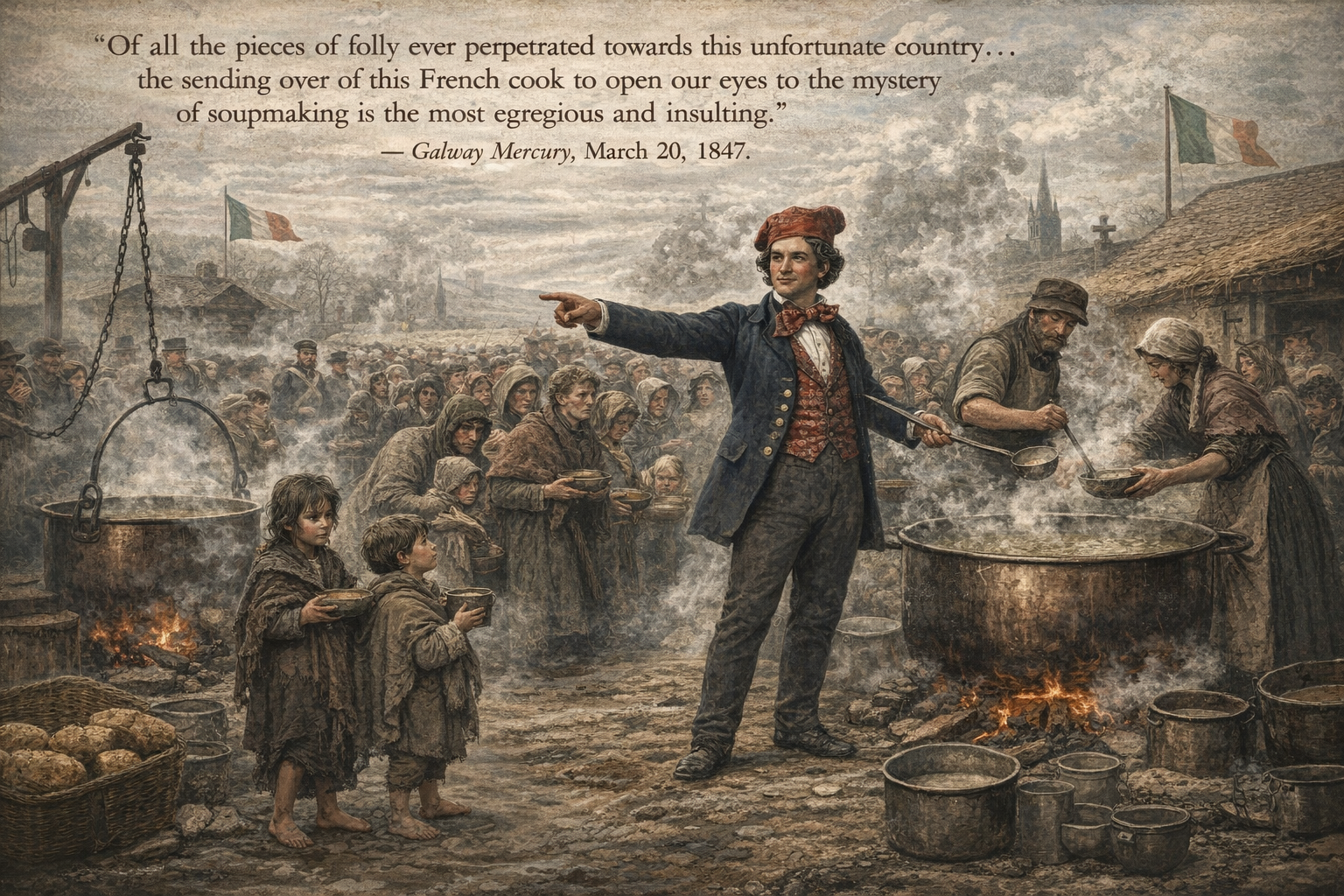
The “French cook” was a Frenchman who had lived in England most of his life. He was probably the most famous chef in England at that time, most notably for his work at the Reform Club, a gentleman’s club which is still in existence in Pall Mall, London. So highly thought of was he that he was asked to design the new kitchens when the club was being re-built. People came from as far as Paris to visit these kitchens.
Alexis Soyer was also an inventor of hundreds of items, sauces (he sold his recipes to Crosse and Blackwell), drinks, patent pots, pans, kettles and teapots, an appliance for rescuing the drowning, entrée dishes, naval kitchens and a stove that was used in the British Army for nearly one hundred years.
His great love was the theatre; his own personality was theatrical, and he dressed in a distinctively flamboyant style. He wrote a ballet, designed pantomime illusions, published cookery books and wrote poetry. He joined Florence Nightingale in the Crimea at the request of the British Government and probably saved hundreds of lives by making the food in the army hospitals edible.
He was an artist at his work, his banquets were legendary especially those for visiting celebrities, his creations were a sensation. In addition to each elaborate menu some special tour de force appropriate to the occasion was created for each banquet. “Le soufflé monstre à la Clontarf” for instance appeared at a dinner given for Daniel O’Connell at the club on the 9 March 1844. O’Connell himself was a member of the Reform Club.
Many may be unaware that in 1845 wet weather ruined the harvest crop in England at the same time that blight destroyed the potato in Ireland. The English were bread eaters which with rising prices the poor could not afford. Early in 1847 Soyer decided that soup kitchens were essential in London, he originated a public subscription heading the list himself. Soon one kitchen in Leicester Square was distributing soup to the poor, and in his usual grandiose manner Soyer sketched out plans for a kitchen supplying twenty thousand people and invented a new type of soup boiler.
Hearing of this success the Lord Lieutenant of Ireland requested the Government to invite Soyer to supervise the building of one of his model kitchens in Dublin.
8,750 people in Dublin received daily rations from 6th April – 14th August 1847.
There can be little doubt about the organisational ability of Alexis Soyer or indeed the charitable and kindly side of his nature, but of the nutritional value of his “Economical Soup” questions were asked by the medical profession at the time and would be an interesting project for some nutritionists to analyse this “meatless invention” at this time of Famine commemoration.
Little did Alexis Soyer realise the extent of his contribution to a new word in the English language – Souperism.
His Number 1 Recipe contained:
1/4 leg of beef
2 gallons of water
2 oz dripping
2 onions and other available vegetables
1/2 lb seconds flour
1/2 lb pearl barley
3 oz salt
1/2 oz brown sugar
TOTAL COST = 1s. 4d
- Recipe No. 2 cost less at £1 per 100 gallons which even in those days might seem exaggerated. For flavour mint, bay leaves, thyme and marjoram were recommended.
- According to the Galway Mercury, Soyer’s soup was not deserving of the praise meted out to the Sisters of Mercy who ran soup kitchens at the quay in Barna and at Father Peter Daly’s residence in Bushypark, then known as Albano Villa.
- Each person was given “a quart of meat soup, such as no man no matter what his rank might be, could be ashamed of at his private table, and with a large cake of substantial unadulterated home-made bread”.
- The Galway Mercury goes on to report that the Barna soup kitchen began to work on the 10th instant (March 1847) and up to the 19th 2,433 were fed gratis.
- It is said that 1,000 per day received soup at Albano Villa also run by the “Ladies of St. Vincent’s Convent”.
- The remains of a suspension apparatus was still visible on the gable wall of Mt. St. Josephs up to the turn of the century. Presumably soup or stirabout was made available by the authorities there.
- Soup boilers were situated in other areas such as Dove Park (Páirc na gColm).
REFERENCES
Helen Morris – Portrait of a Chef (1938) – Reprinted Oxford University Press 1980
Galway Mercury – 20 March 1847.
This article is from our 1997 publication An Gorta Mór i Maigh Cuilinn 1845-1850
No Comments
Add a comment about this page