
Drimneen
Information from Logainm.ie
Irish: Droimnín
Genitive: Dhroimnín
This is a validated name – “Placenames or geographical names whose official, legal Irish versions are specified in various Placenames Orders in accordance with the Official Languages Act 2003. Certain placenames in Northern Ireland are also included in this category, such as counties, cities, towns and various other population centres.”
Information from O’Donnovan’s Field Name Books – (places.webworld.org database)
Irish Form of Name: Druimnín, diminutive of Druim.
Translation: A hill or back.
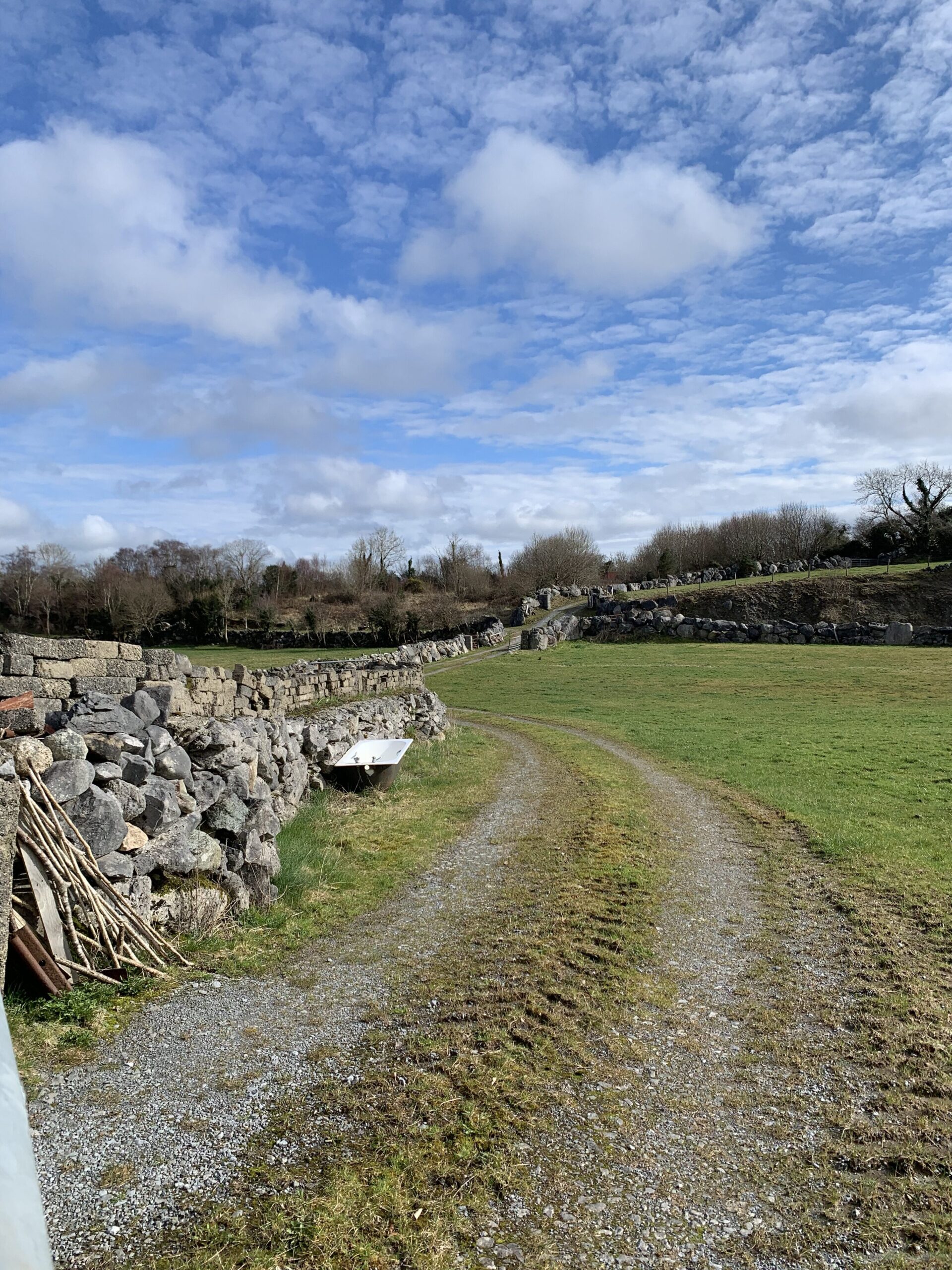
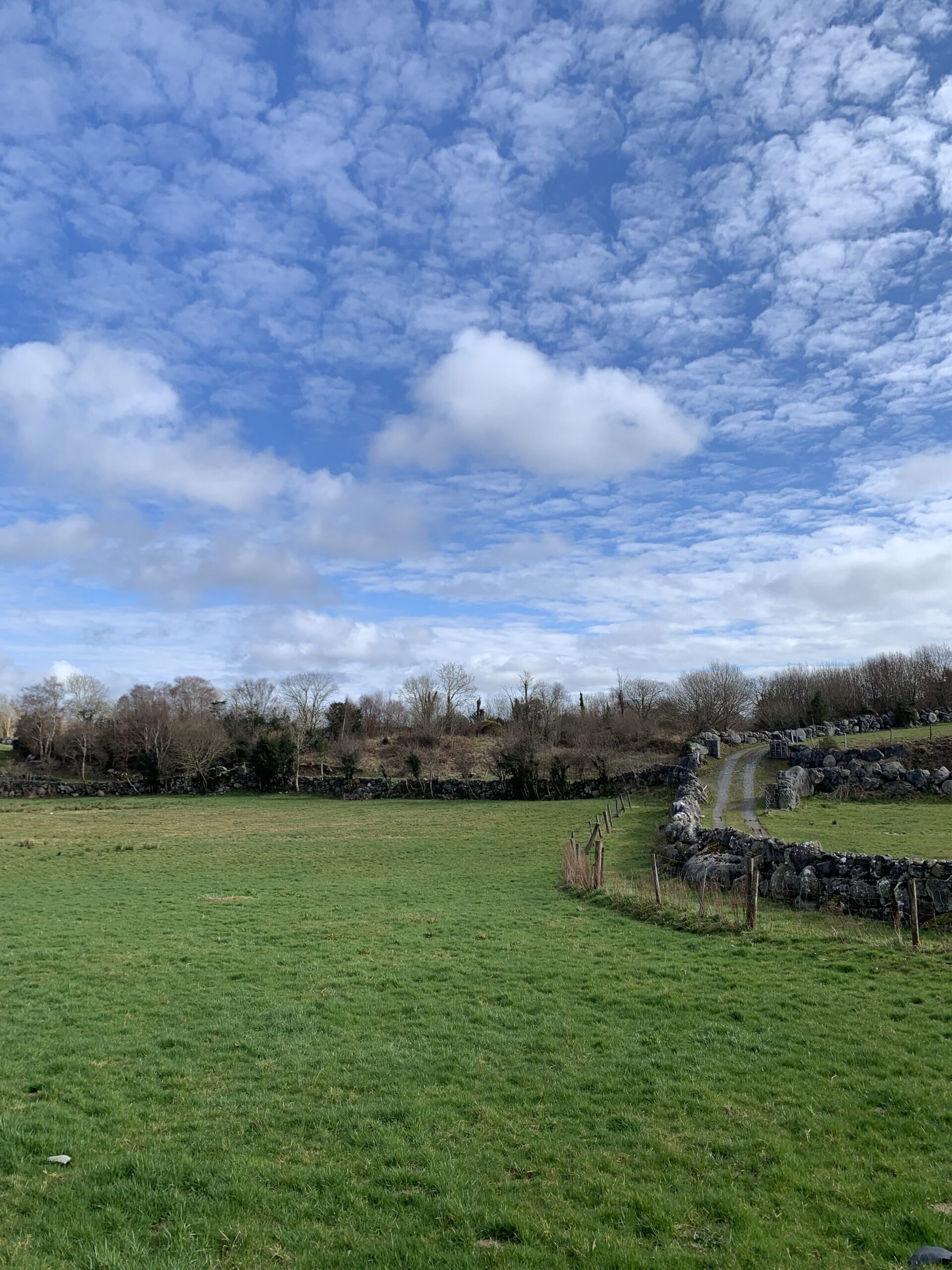
Description: This townland is small. It consists of arable and pasture. Loughheamesconry is on the E. boundary and in the junction between this and Rinneen townland.
Situation: N. of the parish. Bounded on the N. by Rinneen, on E. by Deerfield, on South by Gurtnamona West, and on West by Dove Park and Corbally.
Translation according to P. W. Joyce: Drimneen in Galway ; same as Drimmeen, but with dim. termination nin instead of in.
This is a list of townlands that share a border with this townland:
Information from Moycullen and its People
Iomaire caol íseal cnocáin is ea Droimnín. Tá sé suite idir Gort na bhFia agus Páirc na gColm. Tá Loch Séamus Uí Chonaire idir é agus Cnoc an tSean Bhaile.
Drimneen is a narrow, low ridge of land between Dovepark and Deerfield. Lough Séamus Uí Chonaire separates this townland from Knockshanbally. The Galway/Clifden railway line ran along the northern end of Drimneen.
Griffith’s Valuations 1847-1863
Griffith’s Valuation was a land and property survey conducted from 1847 to 1863. Its purpose was to determine taxes based on land value and soil quality. In the absence of most pre-20th Century census data, Griffith’s can provide crucial insight to those interested in genealogy. The survey was conducted in Moycullen from 1853 to 1855. You can find the record of Drimneen in Griffith’s valuation here.
John O’Flaherty (1) had 56 acres of land valued at 16 pounds and 15 shillings. The immediate lessor/landowner was Anthony O’ Flaherty.
Robert Lynch (a) leased on the same land as John. Robert’s immediate lessor/landowner was Anthony O’ Flaherty. Robert’s holdings included a house and 3 acres, 3 roods, and 14 poles/perches of water, valued at 10 shillings. The total holdings amounted to 59 acres, 3 roods, and 14 poles/perches. The total value was 17 pounds, 5 shillings.
The 1901 Census
According to the Enumerator’s abstract (Form N), Drimneen only had three buildings which were all inhabited houses. All are marked as single family homes. Everyone in Drimneen was Roman Catholic. There were sixteen people residing in the townland at the time of census collection; ten men and six women. The Information on the House and Building Return (Form B1) was collected for all three households on the 2nd of April, 1901. All the dwellings in Drimneen were built of stone or brick, with thatched roofs or other natural materials. According to the Out-Offices and Farm-Steadings Return (Form B2) there were seven additional structures in the townland used for storage and farming; the structures associated with each household will be elaborated on in the relevant writeup. Individuals recorded in each household (Form A) “… slept or abode in this House on the night of Sunday, 31st of March, 1901.” The Enumerator was Constable Matthew Moore.
William Vaughan Household – Form A
William Vaughan was head of House 1 in the townland of Drimneen in the District Electoral Division of Slieveaneena, County Galway. According to the House and Building Return (Form B1), the dwelling was a 2nd class house, made of stone or brick and a thatched roof. With three rooms and three front windows, this was a comfortable home at the time for a family of the Vaughan’s size. The Out-Offices and Farm Steadings Return (Form B2) show the property also had a piggery and a cow house.
The House was occupied by a single Roman Catholic Family, all members of whom were born in County Galway.
William (39) and his wife Annie (31) were both National teachers. They could read and write and spoke both Irish and English.
Their son, Michael Gabriel Vaughan, was a newborn at the time of census collection. On Form A his age is recorded as “7 days”. Form A specifies the information was collected on the night of Sunday, March 31st, 1901.
While William was the householder, it is not clear who the landholder was; the column just has a dash. Form B1 was collected on 2nd April, 1901.
Anne Rushe Household (spelling used on the 1901 Census) – Form A
Anne Rushe was head of the family of House 2 in the townland of Drimneen in the District Electoral Division of Slieveaneena, County Galway. According to the House and Building Return (Form B1), the dwelling was a second class house, made of stone or brick and a thatched roof. With three rooms and three front windows, this was a modest home at the time. The Out-Offices and Farm Steadings Return (Form B2) show the property also had a piggery and a cow house.
The House was occupied by an extended Roman Catholic Family. All members were born in County Galway and could speak both Irish and English.
Anne Rushe (60) was a Farmer. She was a widow and could not read. Three of Anne’s children resided in her home at the time of census collection. William Rushe (30), has his occupation listed as Farmers Son {sic}. Michael Rushe (27), has his occupation listed as a railway labourer. Both men appear in their mother’s home in the 1911 Census with the same occupations.
Bartly Rushe (24) was an Agricultural Labourer. All three men could read and write and were unmarried at the time of census collection.
Mary Griffin (18) was Anne’s Granddaughter, the writing on the census is heavily smudged but just legible. Her occupation is listed as a Farmers Daughter {sic}. Mary could read and write and was unmarried at the time of census collection. It is unclear which of Anne’s children was Mary’s parent.
The householder and landholder recorded on the House and Building Return is Anne Rushe (different spelling than Form A), and the census return for the household was collected on 2nd of April, 1901.
Anne Faherty (22) of Newtown and Bartly Rush (26) of Gortnamona were married 24th September, 1867. Their marriage record shows that their fathers were named Edmond Rush and William Faherty, both of their professions were listed as “herd”.
Their first child, Edmond, was born the 2nd of August, 1868 in Gortnamona. The townland is listed as the place of residence of his father, Bartly. Edmond’s birth record can be viewed here.
William Rush was born the 17th of February, 1872 in Gortnamona. The townland is listed as the place of residence of his father, Bartly. William’s birth record can be viewed here.
Julia Rush was born the 8th of April, 1870 in Deerfield. The townland is listed as the place of residence of her father, Bartly. Julia’s birth record can be viewed here.
Michael Rush was born the 29th of April, 1874 in Drimneen. The townland is listed as the place of residence of his father, Bartly. Michael’s birth record can be viewed here.
Bridget Rush was born the 2nd of May, 1876 in Drimneen. Bridget’s birth record can be viewed here.
Bartholomew Rush was born the 27th of April, 1878 in Drimneen. Bartholomew’s birth record can be viewed here.
Bartholomew Rush died at the age of forty of liver disease on the 12th of November, 1878 in Drimneen. His death record can be found here.
William Rush Household – Form A
William Rush was the head of House 3 in the townland of Drimneen in the District Electoral Division of Slieveaneena, County Galway. According to the House and Building Return (Form B1), the dwelling was a third class house, made of stone or brick and a thatched roof. With three rooms and two front windows, this was a modest home at the time. The Out-Offices and Farm Steadings Return (Form B2) show the property also had a stable, a piggery and a cow house.
The householder and landholder recorded on the House and Building Return is William Rushe (different spelling than on Form A), and the census return for the household was collected on 2nd of April, 1901.
The House was occupied by an extended Roman Catholic Family. All members were born in County Galway.
William Rush (43) was a Farmer. William could Read and read {sic}, and spoke both Irish and English.
His wife, Mary Rush (36), has her occupation recorded as Farmers Wife {sic}. It should be noted that Mary is recorded as being able to read and write in 1901, and not able to do either in 1911. Both William and Mary spoke Irish and English.
William’s mother, Julia Rush (80) lived in her son’s home at the time of census collection. Her occupation is listed as a Farmer (this is crossed out), and she was a widow. Julia could not read and spoke only Irish.
Backtracking from the 1911 Census, we know that all five of the Rush children recorded in 1911 also appear on the 1901 Census. Edward’s (14) occupation was listed as a Farmers Son {sic}. He could read and write, spoke both Irish and English, and was not married.
Patrick (12), Julia (10), Bartly (7), and Michael (3), have their occupations listed as “Scholar” which means they went to school. Patrick and Julia could read and write. Bartly could only read. Micheal could not read. In the two youngest sons’ language column, the word “English” was written and then appears to have been erased and crossed out for both. There is a thick line for both of the letters. This could mean they spoke English and Irish like their siblings, or that their language proficiency is unclear. All of the Rushe children are listed as unmarried.
Patrick’s birth record shows his mother’s maiden name was Caufield. His birth record can be viewed here.
The 1911 Census
Just as in 1901, the Enumerator’s abstract ( N1 pg 1) shows that Drimneen had three buildings which were all inhabited houses, all marked as single family homes. Everyone in Drimneen was Roman Catholic. Also as in 1901, there were nineteen people residing in the townland at the time of census collection; ten men and six women. According to the House and Building Return (Form B1), the dwellings in this townland were third-class houses, made of stone or brick with thatched roofs. According to the Out-Offices and Farm-Steadings Return (Form B2) there were eleven additional structures in the townland used for storage and farming; the structures associated with each household will be elaborated on in the relevant writeup. The Enumerator’s Abstract (N1 pg 2) was signed by Constable Johnston Morrison on the 12th of April, 1911. Individuals recorded in each household (Form A) for Drimneen “… slept or abode in this House on the night of Sunday, 2nd of April, 1911.”
William Vaughan Household – Form A
William Vaughan was the head of House 1 in the townland of Drimneen in the District Electoral Division of Slieveaneena, County Galway. According to the House and Building Return (Form B1), the dwelling was a second-class house, made of stone or brick and a thatched roof. With three rooms and three front windows, this was a comfortable home at the time for a family of the Vaughan’s size. The Out-Offices and Farm Steadings Return (Form B2) show the property also had a stable, a piggery, a cow house and a shed.
The home was occupied by an extended Roman Catholic family.
William Vaughan (49) and his wife, Annie (43) were both National Teachers. Of the five national schools in Moycullen, they taught at the Newtown school. They had been married for thirteen years and had two children; Michael Gabriel (10) and Margaret C M (3). Michael Gabriel is listed as a scholar, meaning he attended school. The Vaughan’s were a Roman Catholic family, and all four members were born in Co. Galway. Annie and Michael Gabriel spoke both Irish and English, while William and Margaret C M only spoke English. The three oldest Vaughans could read and write.
At the time of the 1911 census, William’s niece, Mary Ann Griffin (19) was present in the home. She was born in Co. Fermanagh (spelled Fermangh on the census) was single, and had no occupation listed. She was also Roman Catholic, could read and write, and spoke only English.
The landholder recorded on the House and Building Return was William Vaughan himself, and the census return for the household was collected on 12th of April, 1911.
William Rush Household – Form A
William Rush was the head of House 2 in the townland of Drimneen in the District Electoral Division of Slieveaneena, County Galway. According to the House and Building Return (Form B1), the dwelling was a third-class house, built of stone with a thatched roof. With three rooms with two front windows, the building is an example of the modest but functional housing typical of rural Moycullen at the turn of the twentieth century. The Out-Offices and Farm Steadings Return (Form B2) show the property also had a stable, a piggery, a cow house, a barn, and a shed.
The home was occupied by a single Roman Catholic family. All members were born in Co. Galway and spoke both Irish and English.
William Rush (59) was a Farmer. He could read and write. His wife, Mary (50) could not read or write. Her occupation column is blank. The couple reported being married for twenty-six years and they had five children. This information was incorrectly filled out in the husband’s column, where it should be in the wife’s.
All five Rush children resided in House 2 at the time of Census collection. They were all able to read and write, and spoke Irish and English. They are all listed as single. Edward (25) and Patrick (22) have their occupations listed as “Farm Servant”. Julia’s (19) occupation column is blank. The youngest sons, Bartly (15) and Michael (12), have their occupations listed as “Scholar”, which means they went to school.
The landholder recorded on the House and Building Return was William Rush himself, and the census return for the household was collected on 12th of April, 1911.
Anne Rush Household – Form A
Anne Rush was the head of House 3 in the townland of Drimneen in the District Electoral Division of Slieveaneena, County Galway. According to the House and Building Return (Form B1), the dwelling was a third-class house, built of stone with a thatched roof. With two rooms with two front windows, the building is an example of the modest but functional housing typical of rural Moycullen at the turn of the twentieth century. The Out-Offices and Farm Steadings Return (Form B2) show the property also had a piggery and a cow house.
The home was occupied by a multi-generation Roman Catholic family.
Anne Rush (70) was born in Co. Galway and was a widow. Her occupation column is blank. Widows were not required to give information on how many years she was married, how many children were born alive, and how many children were alive at the time of census collection. However, it is recorded that she was married 41 years. Anne spoke Irish and English and could not read or write. Because of this, Anne’s signature was written for her on the census declaration (Form A) by Constable Johnston Morrison, acting as witness and census taker. An “x” written by Anne is present by her name, as required.
William Rush (38) was Anne’s son. He was a Farmer, born in Co. Galway. He spoke Irish and English and could read and write. William was unmarried.
Michael Rush (34) was Anne’s son. He was a Railway Servant born in Co. Galway. He spoke Irish and English and could read and write. Michael was also unmarried.
William Rush (12) was Anne’s Grandson. He was born in America, could read and write, and spoke English only. It is unclear from the Census which of Anne’s children would be William’s father or mother, and if they were living in House 3. William’s occupation is listed as “Scholar”, which means he went to school.
The House and Building Return for House 3 only has dashes written on it, and the return for the household was collected on 12th of April, 1911.
No Comments
Add a comment about this page