
Information from Logainm.ie
Irish: Gort na Móna Thoir
Genitive: Ghort na Móna Thoir
Non-validated name: Placenames or geographical names for which provisional Irish forms have been recommended by the Placenames Branch on the basis of research but which are not specified in Placenames Orders in accordance with the Official Languages Act 2003.
The Irish words gort or gart means field in English. Móin and mónaidh translates to bogland.
Information from O’Donnovan’s Field Name Books – (places.webworld.org).
Standard Name: Gortnamona
Irish Form of Name: Gort na Móna
Translation: Field of the bog
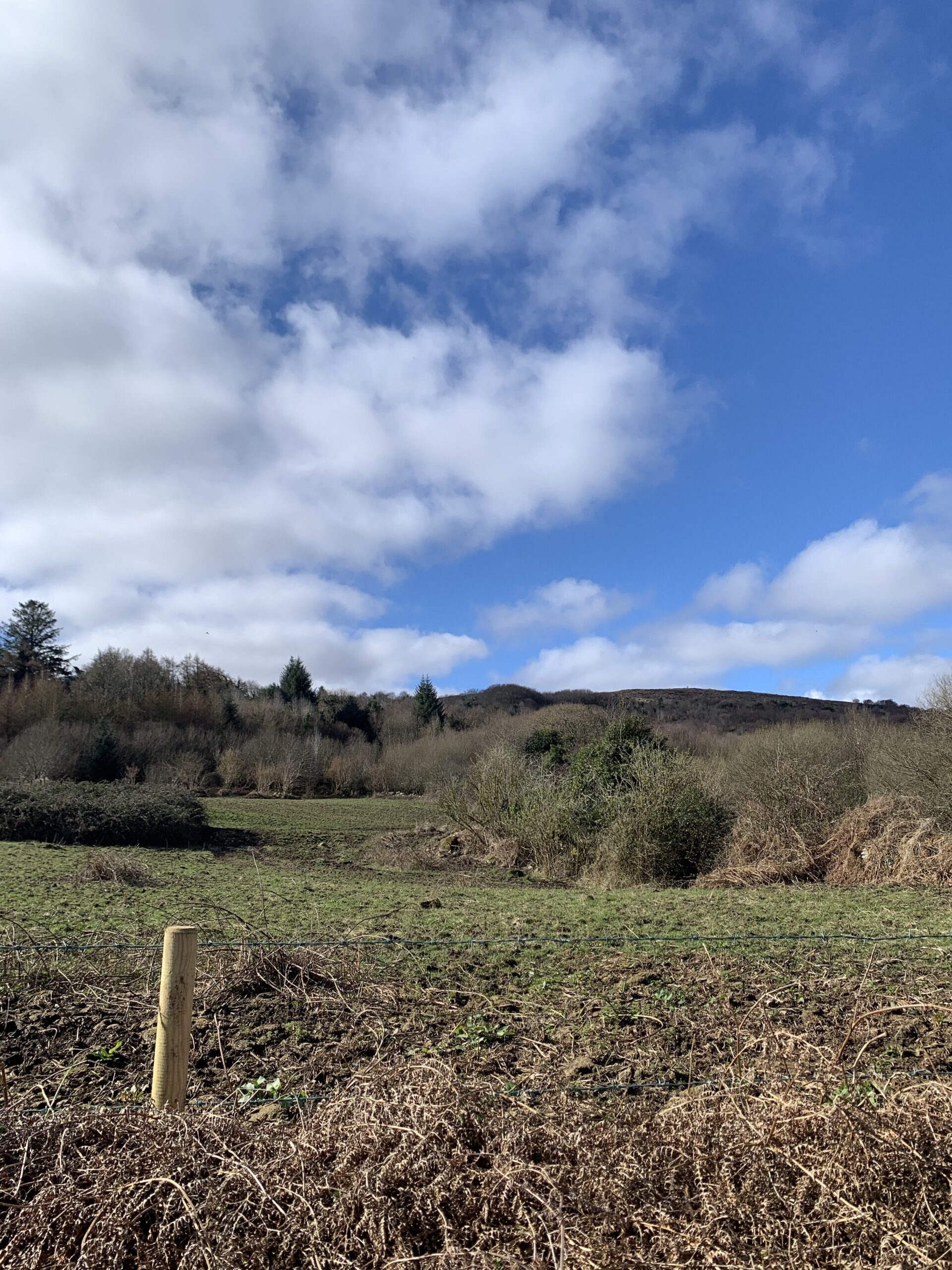
Description: This townland is partially cultivated about the centre being composed of rough boggy land, rocks and furze.
Information from Moycullen and its People
Ciallaíonn Gort na Móna páirc portaigh.
Gort na Móna literally means, the field of the bog
Townland History and Description
Gortnamona is a townland that is divided into Gort na Móna Thiar, west and Gort na Móna Thoir, east. Part of the ruin of the Gort na Móna house can still be seen today.
Griffith’s Valuations
Griffith’s Valuation was a land and property survey conducted from 1847 to 1863. Its purpose was to determine taxes based on land value and soil quality. In the absence of most pre-20th Century census data, Griffith’s can provide crucial insight to those interested in genealogy. The survey was conducted in Moycullen from 1853 to 1855. Gortnamona East in Griffith’s Valuation can be found here.
Malachy Keady (1) leased a holding of 83 acres, 2 roods and 30 poles/perches. The immediate lessor was Christopher Blake. It appears Keady jointly-leased the land with John Conroy (1a). Where Keady only leased land, Conroy leased land and buildings (the “a” by his name corresponds with the location of his home on the map). His immediate lessor was Keady. The land was jointly valued at £20.00 (£10.00 each) and the house and offices were valued at 12 shillings. Their total valuation was £20.12 shillings.
Catherine Walsh leased a house and land (1 acre, 1 rood and 24 perches ) from James Kilkelly. The valuation was 10 shillings for the land and 1 pound, 10 shillings for the house, totaling two pounds all together.
In total, there were 85 acres and 14 poles/perches in Gortnamona East. All rateable property in the townland was valued at 22 pounds, 12 shillings annually.
The 1901 Census
According to the Enumerator’s abstract (Form N), Gortnamona East only had one building which was an inhabited house. Everyone in Gortnamona East was Roman Catholic. There were eight people residing in the townland at the time of census collection; five men and three women. The Information on the House and Building Return (Form B1) was collected on the 9th of April, 1901. The dwellings in Gortnamona East was built of stone or brick, with a thatched roof or other natural materials. According to the Out-Offices and Farm-Steadings Return (Form B2) there were five additional structures in the townland used for storage and farming. Individuals recorded in each household (Form A) “…slept or abode in this House on the night of Sunday, 31st of March, 1901”. The Enumerator was Constable Johnston Morrison.
Martin Conroy Household – Form A
Martin Conroy Martin Conroy was the head of House 1 in the townland of Gortnamona East, in the District Electoral Division of Tullokyne, County Galway. According to the House and Building Return (Form B1) the dwelling was a third-class house, built of stone with a thatched roof and contained three rooms with two front windows. This is reflective of the modest but functional housing typical of rural Moycullen at the turn of the twentieth century. The Out-Offices and Farm-Steadings Return (Form B2) shows that included on the property was a stable, two cow houses, a calf house, and a piggery.
The home was occupied by a single Roman Catholic family. All members were born in Co. Galway, and could read and write.
Martin Conroy (58) was a Farmer. His wife, Katherine (56), had her occupation listed as a Farmers Wife {sic}. Both of them could read and write.
Six of Martin Conroy’s children lived in their father’s home at the time of census collection, all of them were unmarried. John (26) and Patrick (22) have their occupations listed as Farmers Son {sic}. Both men could speak Irish and English. Mary (24) and Honor (19) have their occupations listed as Farmers Daughter {sic}. Both women spoke only English. Thomas (15), Joseph (13) are listed as scholars, meaning they attended school. Both boys spoke English only.
In the age column meant for infants under one, numbers were written and erased for all the children; some are still legible. John has a 1, Mary has a 6, Honor has a 8, and Thomas has an 8.
The householder recorded on the House and Building Return was Martin Conroy himself, and the census return for the household was collected on 9th of April, 1901.
The 1911 Census
According to the Enumerator’s abstract (Form N pg2), Gortnamona East only had one building which was an inhabited house. Everyone in Gortnamona East was Roman Catholic. There were five people residing in the townland at the time of census collection; three men and two women. The Information on the House and Building Return (Form B1) was collected on the 9th of April, 1901. The dwelling in Gortnamona East was built of stone or brick, with a thatched roof or other natural materials. According to the Out-Offices and Farm-Steadings Return (Form B2) there were five additional structures in the townland used for storage and farming. Individuals recorded in each household (Form A) “…slept or abode in this House on the night of Sunday, 2nd of April, 1911”. The Enumerator was Constable Johnston Morrison.
Martin Conroy Household – Form A
Martin Conroy was the head of House 1 in the townland of Gortnamona East in the District Electoral Division of Tullokyne, County Galway. According to the House and Building Return (Form B1) the dwelling was a third-class house, built of stone with a thatched roof and contained three rooms with three front windows. This is reflective of the modest but functional housing typical of rural Moycullen at the turn of the twentieth century. The Out-Offices and Farm Steadings Return (Form B2) shows that included on the property was a stable, a cow house, a piggery, a fowl house, and a shed.
The home was occupied by a single Roman Catholic family. All members were born in Co. Galway, could read and write, and were speakers of both Irish and English.
Martin Conroy (67) was a Farmer. His wife, Catherine (66), has no occupation listed. The couple had been married 37 years as of 1911. They had seven children, six of whom were still living at the time of census collection.
Three of the six living Conroy children resided in House 1. John (36) and Joseph (23) are listed as a Farmers Son {sic} as their occupations. Honor (27) is listed as a Farmers Daughter {sic} as her occupation. All three siblings were unmarried.
The householder recorded on the House and Building Return was Martin Conroy himself, and the census return for the household was collected on 8th of April, 1911.
No Comments
Add a comment about this page