
Information From logainm.ie
Irish: An Chora
Genitive: na Cora
Non-validated name: Placenames or geographical names for which provisional Irish forms have been recommended by the Placenames Branch on the basis of research but which are not specified in Placenames Orders in accordance with the Official Languages Act 2003.
The Irish words cora, coraidh and corann translates to weir, stone-fence and ford in English.
Information from O’Donnovan’s Field Name Books – (places.webword.org).
Standard Name: Curra
Irish Form of Name: Currach
Translation: A moor.
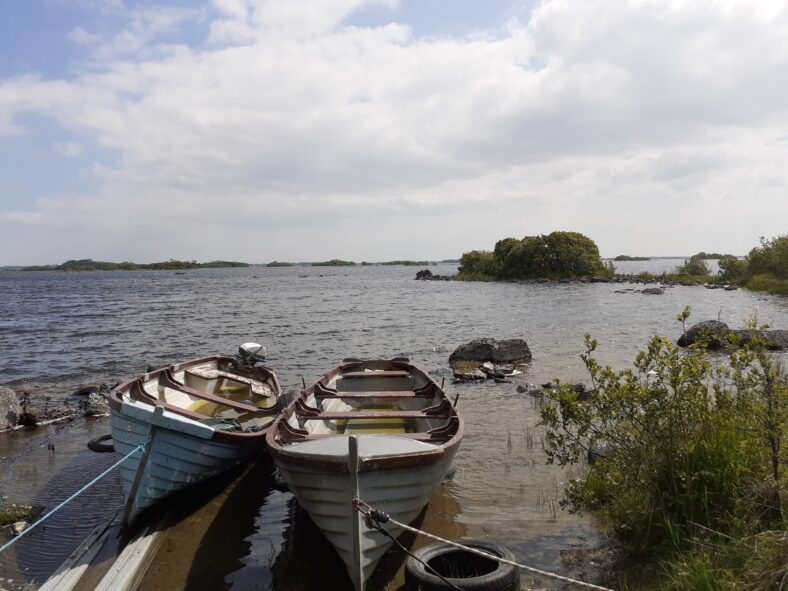
Description: The whole of this townland is a continual sheet of lime stone rock with the exception of two or three small spots in cultivation. There are a few houses in this townland. There are some islands at the South and along the eastern boundary in Lough Corrib.
Situation: E. of the parish. Bounded on North by Portarragh, on E. and S. by Lough Corrib and on West by Kilcluggaun and part of the Lough before mentioned.
Other place names in this townland:
Some other placenames in or near this townland are…
- Birtnahapeen Rocks (rock)
- Illaunacurra 3 islands (island)
- Otter Island (island)
- Otter Island (island)
- Tonamore (rock)
- White Island (island)
Information from Moycullen and its People
Talamh leibhéalta íseal is ea currach nó corrach. Tá seans ann go mbeadh an talamh seo faoi uisce nuair a ardaítear uiscí na Coiribe.
A currach is a level, low-lying plain. The plain may flood in wintertime, when Lough Corrib’s waters rise.
Blake Census 1793-1813
Curragh: Thomas Boughan (W.’02), William Liddane, Ed. Duane (R.’06).
Curra is also mentioned elsewhere in Moycullen and its People, in the writeup for the townland of Tumnasrah:
…Fifty years ago there were only two houses in this townland. Today, there are seven houses. The people of Tumnasragh would visit Curra by boat on moonlit nights.
-Mary Connell
Griffith’s Valuations 1853-1855
Griffith’s valuation was a land and property survey conducted from 1847 to 1863. Its purpose was to determine taxes based on land value and soil quality. In the absence of most pre-20th Century census data, Griffith’s can provide crucial insight to those interested in genealogy. The survey was conducted in Moycullen from 1853 to 1855. You can find the record of Curra in Griffiths valuation here.
Thomas Bohan is the only person listed for Curra in Griffiths Valuation. He leased 174 acres, 3 roods and 3 poles/ perches from his immediate lesser/landowner Lord Campbell.
Thomas’s holding included “House, offices and land.” The valuation of the landholding was 24 pounds, and the house at 12 shillings. The total annual valuation of Thomas Bohan’s holding was 24 pounds, 12 shillings.
The 1901 Census
According to the Enumerator’s abstract (Form N), Curra only had two buildings which were all inhabited houses. All are marked as single family homes. Everyone in Curra was Roman Catholic. There were thirteen people residing in the townland at the time of census collection; five men and eight women. The information on the House and Building Return (Form B1) was collected for all three households on the 6th of April, 1901. All the dwellings in Curra were built of stone or brick, with thatched roofs or other natural materials. According to the Out-Offices and Farm-Steadings Return (Form B2) there were ten additional structures in the townland used for storage and farming; the structures associated with each household will be elaborated on in the relevant writeup. Individuals recorded in each household (Form A information) for Curra slept or abode in this House on the night of Sunday, 31st of March, 1901. The Enumerator was Constable Matthew Moore.
Timothy Bohan Household – Form A
Timothy Bohan was the head of House 1 in the townland of Curra in the District Electoral Division of Tullokyne, County Galway. According to the House and Building Return (Form B1), the dwelling was a third-class house, made of stone or brick with a thatched roof. With three rooms and one front window, the building is an example of the modest but functional housing typical of rural Moycullen at the turn of the twentieth century. The Out-Offices and Farm Steadings Return (Form B2) show the property also had a stable, a cow house, a piggery, and a fowl house.
The home was occupied by a multi-generational Roman Catholic family, all members of whom were born in Co. Galway and spoke both Irish and English.
Timothy (60) was a farmer. His wife, Anne (58), has her occupation listed as Farmers Wife {sic}. The couple could not read or write.
Two of Timothy’s children resided in House 1 at the time of census collection. Kate Bohan (19) was a Farmers Daughter {sic}. She was not married, and could read and write. Catherine “Kate” Bohan was born June 11, 1882 in Curragh {sic} (birth record here.) We learn from Kate’s birth record that her mother’s maiden name was Mullin.
Thomas Bohan (29) was a Farmers Son {sic}. His wife, Anne (29), is listed as son’s wife {sic} in her occupation column. Anne could read and write, but Thomas could not.
The householder recorded on the House and Building Return was Timothy Bohan, and he was the landholder as well. The census return for the household was collected on 6th April, 1901.
Thomas Bohan Household – Form A
Thomas Bohan was the head of House 2 in the townland of Curra, in the District Electoral Division of Tullokyne, County Galway. According to the House and Building Return (Form B1), the dwelling was a second-class house, made of stone or brick with a thatched roof. With three rooms and three front windows, reflecting the modest but functional housing typical of rural Moycullen at the turn of the twentieth century. The Out-Offices and Farm Steadings Return (Form B2) show the property also had a stable, a cow house, a piggery, a fowl house, a barn, and another undescribed kind of out-office.
The householder recorded on the House and Building Return was Thomas Bohan, and he was the landholder as well. The census return for the household was collected on 6th April, 1901.
The home was occupied by a multi-generational Roman Catholic family. All members were born in Co. Galway and spoke both Irish and English.
Thomas Bohan (70) was a Farmer. His wife, Margaret Bohan (68), has a dash in her occupation column. Thomas was able to read, Margaret could not.
One of Thomas’s children resided in his home at the time of census collection. John Bohan (31) was a Farmers Son {sic}. He could read and write. His wife, Margaret (30), has her occupation listed as House work {sic}. The couple had two children. Thomas (1) and Mary (one month).
Both children are recorded as not being able to read or write, but also marked as able to speak Irish and English.
Mary was born 3rd March, 1901 in Curragh {sic}. Her mother’s maiden name was Lydon (birth record here). Mary Bohan died 13th May, 1901 of whooping cough. There appears to have been an outbreak in Moycullen in the Spring of 1901, as many small children passed away from the disease at this time. Mary’s death record can be found here.
Two other people resided in House 2 at the time of census collection; they are both recorded as Thomas Bohan’s nieces.
Margaret Hurney (6) and Kate Hurney (4) were both listed as scholars, meaning they attended school. Both girls could not read.
The Hurney girls were the daughters of Laurence and Margaret Hurney. Margaret was Laurence’s first wife. Laurence Hurney (28), from the townland of Clooniff, married Maggie {sic}Bohan (23) of Curragh {sic} the 26th of January, 1891 (marriage record here). Their fathers were Thomas Hurney and Thomas Bohan, both of whom were Farmers.
The circumstances that eventually lead to Laurence’s second marriage are unclear. There are no records that give a clear answer into the fate of Margaret Hurney that were found at this time.
Laurence and Margaret Hurney are not found on the 1901 Census in the Moycullen area.
Margaret Hurney was born January 21st 1894 in the townland of Clooniff, her birth record can be found here. On the form, Laurence Hurney’s dwelling was labelled as Clooniff as well.
Kate Hurney was born 27th September, 1895, in Curragh {sic}, the record can be found here.
Laurence Hurney appears in the 1911 Census in the townland of Gortachalla. Kate Hurney (15) was living with her cousin Richard Connor down the road from her father in 1911.
The 1911 Census
According to the Enumerator’s abstract (Form N pg 2), Curra only had two buildings which were all inhabited houses. All are marked as single family homes. Everyone in Curra was Roman Catholic. There were thirteen people residing in the townland at the time of census collection; five men and eight women. The information on the House and Building Return (Form B1) was collected for all three households on the 6th of April, 1901. All the dwellings in Curra were built of stone or brick, with thatched roofs or other natural materials. According to the Out-Offices and Farm-Steadings Return (Form B2) there were ten additional structures in the townland used for storage and farming; the structures associated with each household will be elaborated on in the relevant writeup. Individuals recorded in each household (Form A information) for Curra slept or abode in this House on the night of Sunday, 31st of March, 1901. The Enumerator was Constable Matthew Moore.
John Bohan Household – Form A
John Bohan lived in House 1 in the townland of Curra in the District Electoral Division of Tullokyne, County Galway. According to the House and Building Return (Form B1), the dwelling was a second-class house, made of stone or brick with a thatched roof. With three rooms and three front windows, this was a standard, if not elevated living situation in rural Moycullen at the time. The Out-Offices and Farm Steadings Return (Form B2) show the property also had a stable, cow and calf houses, a piggery, a fowl house, and a barn.
The home was occupied by a multi-generation Roman Catholic family.
John Bohan (42) was a Farmer born in Co. Galway. His wife, Maggie (42), was also from Co. Galway. She has no occupation listed. The couple reports being married 12 years as of 1911. Maggie gave birth to four children, only two of whom were still alive by the time of census collection. Both John and Maggie could read and write and spoke Irish and English.
Maggie Bohan (80) was John’s mother. She was a widow and could not read or write. She spoke only Irish. Maggie’s occupation was written down but then erased, and is now illegible. Widows were not required to give information on how many years she was married, how many children were born alive, and how many children were alive at the time of census collection. However, this information was also recorded in Maggie’s case, but was also scratched out. The number six is still visible in the column for how many children were alive at the time of census collection. Interestingly, Maggie’s county or country of origin was not recorded, the column is blank.
John and Maggie’s two living children were Thomas (11) and Patrick (9). The boys were born in Co. Galway, could read and write, and spoke both Irish and English. Thomas and Patrick are both listed as “Scholar”, meaning they attended school.
The householder recorded on the House and Building Return was John Bohan himself, and he was the landholder as well. The census return for the household was collected on 11th April, 1911.
Timothy Bohan Household
Timothy Bohan lived in House 2 in the townland of Curra in the District Electoral Division of Tullokyne, County Galway. According to the House and Building Return (Form B1), the dwelling was a third-class house, made of stone or brick with a thatched roof. With three rooms and one front window, the building is an example of the modest but functional housing typical of rural Moycullen at the turn of the twentieth century. The Out-Offices and Farm Steadings Return (Form B2) show the property also had a stable, cow and calf houses, a piggery, and a fowl house.
The home was occupied by a multi-generation Roman Catholic family. All members of whom were born in Co. Galway and spoke both Irish and English.
Timothy Bohan (69) was a Farmer and was unable to read. Because of this, Timothy’s signature was written for his on the census declaration (Form A) by Constable Michael Lyster, acting as witness and census taker. An “x” written by Timothy is present by his name, as required.
Timothy’s wife was Anne Bohan (71). She has no occupation listed, and she was unable to read as well. The couple reported being married for forty-four years as of 1911. Anne gave birth to eight children, seven of whom were still alive at the time of Census collection.
Tom Bohan (40) was Timothy’s son. He was a Farmer and was able to read. His wife, Anne (40) has no occupation listed. The couple reported being married for eleven years as of 1911. They had four children, all of whom lived in House 2 at the time of Census collection.
Brigid (10), Timothy (9), Joseph (7), and Mary (4) are all listed as single. The three oldest Bohan children could read and write, and all are listed as “Scholar”, meaning they attended school. Mary’s language proficiency is recorded, but her reading and writing capability is blank. Her occupation is marked with a dash.
The householder recorded on the House and Building Return was Timothy Bohan himself, and he was the landholder as well. The census return for the household was collected on 11th April, 1911.
No Comments
Add a comment about this page