
Over the years many Gardaí coming from all parts of the country have diligently served our Moycullen community. Equally, many young Moycullen men and women who joined the force, often following a family tradition, have served throughout the country.
Some of our local Gardai have distinguished themselves in many different ways. John Leonard, Knockaunranny, won the Scott Medal in 1988, Lorraine Walsh Cloonnabinnia, received the Duais Bhord na Gaelige Award for being the most outstanding Irish language student into 2002. A few of our Gardai also worked overseas representing an Garda Síochána including Ray Lyons with the United Nations and Gerard Clancy, Gorthyloughlin in Japan. Many have distinguished themselves in sport representing Moycullen hurling and football clubs and played for the county too. In 1933 Gardaí Whynne and Finnerty defeated Spiddal Gardai in the final of the District Handball Doubles Championship.
Even in retirement some of the Gardai, Bernard (Barney) Sweeney, for example, who was a member of Conradh na Gaeilge, but also a member of the Moycullen Community Council, continued to share their skills and give their time to enhance the community of which we are all a part.
Gardaí born in Moycullen.
| Surname | Forename | Townland |
| Acton | James J | Knockaunranny |
| Acton | John | Knockaunranny |
| Bane | Patrick | Drimmavohaun |
| Caulfield | Hugh | Portdarragh |
| Clancy | Gerald | Gortyloughlin |
| Clancy | James | Drummaveg |
| Clancy | Seamus | Gorthyloughlin |
| Clancy | Tomás | Gorthyloughlin |
| Conneely | Tommy | Oldtown |
| Conneely | Michael | Kylebroughlan |
| Connor | John | Lealetter |
| Connor | Tommie | Lealetter |
| Crofton | John | Gorthyloughlin |
| Croke | Aidan | Ballyquirke West |
| Cuffe | Shane | Killarainey |
| Cuffe | Vincent | Lealetter |
| Hoare | Michael | Moycullen |
| Fox | Eric | Knockshanbally |
| Griffin | Damien | Rineen |
| O’Halloran | Andrew | Correnellistrum |
| O’Halloran | Christy | Correnellistrum |
| O’Halloran | John | Correnellistrum |
| O’Halloran | Martin | Correnellistrum |
| Kyne | George(Pat) | Loughwell |
| Kyne | Michael | Deerfield |
| Lee | Pat | Cloonmore |
| Leonard | Sean | Knockaunranny |
| Lydon | Mark | Drummaveg |
| Lydon | Seamus | Drummaveg |
| Madden | Tommy | Killagoola |
| Melia | Patrick | Knockshanbally |
| Molloy | Robert | Tullokyne |
| Molloy | Mary | Tullokyne |
| O’Connor | Sean | Kylebroughlan |
| O’Dea | Roísín | Cloonnabinnia |
| O’Dea | Susan | Cloonnabinnia |
| Osborne | Michael | Cloonmore |
| O’Sullivan | Senan | Gorthyloughlin |
| Ryan | Hugh | Tullokyne |
| Sullivan | Martin | Knockarasser |
| Walsh | Damien | Cloonnabinnia |
| Walsh | Hugh | Kylebroughlaun |
| Walsh | Jim | Lealetter |
| Walsh | Liam | Kylebroughlaun |
Garda Gerald Clancy (Gorthyloughlin).
Gerald shared his story
It was a fine summer’s evening in 1959 and Gerald was playing handball in the Moycullen handball alley when Sergeant Crofton stuck his head in and asked him to call back to the Garda Station when his game was finished. Gerald was not sure what he had done wrong but went along anyway.
At the station Sergeant Crofton had an array of documents spread across the desk and suggested Gerald sign them. When he asked the Sergeant what they were for he told him they were forms to join the Gardaí. Gerald duly signed the forms. The following January he did the Civil Service Examination and the required medical examination and left Moycullen on the 12th July 1960 for Dublin. On the 13th July 1960 Gerald Clancy was sworn in as a member of An Garda Síochána at the Phoenix Park Depot, Dublin.
Later in his career Gerald was fortunate to be selected to represent An Garda Síochána in Japan. The World Trade Exhibition was being held there and the Japanese government requested that three policemen from each country taking part should attend. Gerald was one of the three Gardaí chosen to represent Ireland.
“This was March 1970” he said “we stayed in Osaka, Kyoto and Tokyo” They were the first Irish police to fly across the North Pole and to land in Alaska. From Alaska they flew to Kyoto.
Gerald spoke about the differences in the world since then. He said that it took five hours to book a telephone call from Tokyo to Dublin, now you can carry your phone in your back pocket.
Telephone interview with Moycullen Heritage, 22nd September 2023.
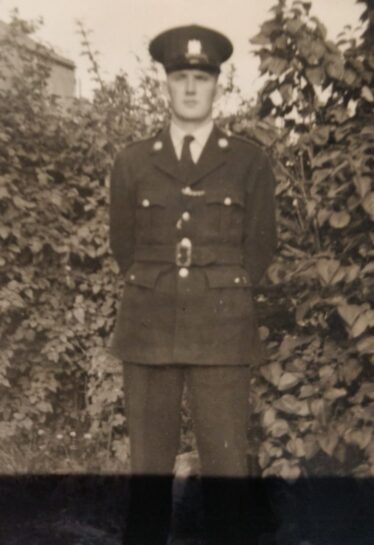
Garda Gerald Clancy. Photo courtesy of Kenneth Clancy
Garda James Clancy (Drummaveg) and nephews Garda Seamus and Garda Tomás Clancy (Gorthyloughlin).
James Clancy from Drummaveg, joined An Garda Síochána in 1935. He trained at the Phoenix Park College, Dublin and was stationed in Waterville County Kerry and later in Loughrea, County Galway where he eventually retired having served in the force for 31 years.
Later in the 1960s and early 1970s James Clancy’s nephews Seamus and Tomás joined the force. By now the training college was based in Templemore, County Tipperary. Both young gardai served initially at Pearse Street station, Dublin. Tomás was then stationed in Kilrickle, County Galway for most of his career until his retirement in 1997 after 31 years’ service. Seamus was stationed at Kilronan Garda station on the Aran Islands but sadly passed away in April 1976 at the young age of 27 years.
Judy Clancy, sister of Thomas and Seamus married Michael Hoare (son of local Sergeant Liam de hÓra). Judy’s husband joined the force and spent most of his working life in Dublin where he became a Detective Superintendent.
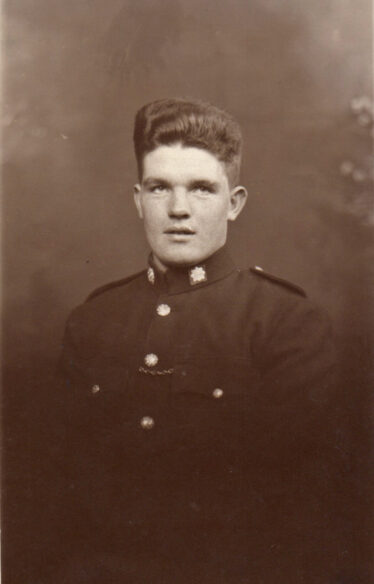
Garda James Clancy 1935. Photo courtesy of Patsy Clancy
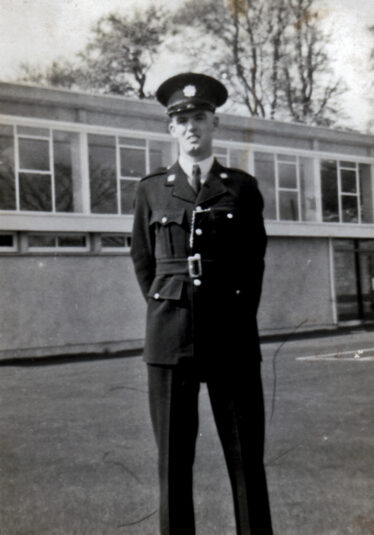
Garda Tomás Clancy. Photo courtesy of Patsy Clancy
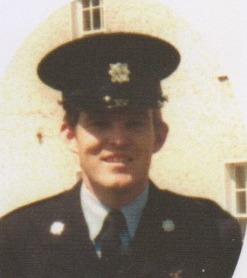
Garda Seamus Clancy. Photo courtesy of Patsy Clancy
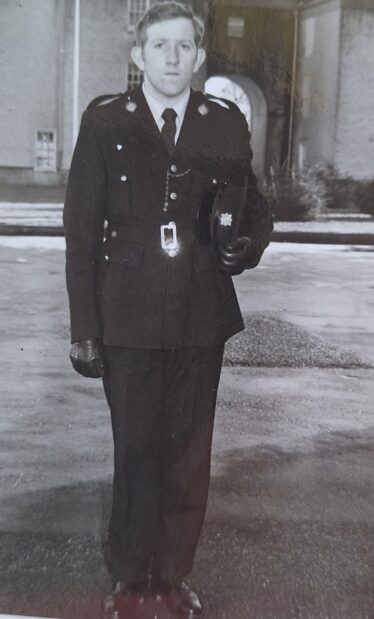
Garda Tommie Connor, Lealetter. Courtesy of Moycullen Heritage.
Garda Sean (John) Leonard (Knockaunranny).
John Leonard, was stationed in Crumlin Garda Station, Dublin on the 19th February 1987 when he was called to the scene of a robbery. He gave chase to a van and managed to grab the driver. A gun was then put to his head. The trigger was pulled but luckily the gun did not fire. Another robber then opened fire and John was shot in the arm. He was forced to release the driver who then escaped. According to the Gardaí a gun and two bags of money were later recovered from the van. John was taken to St. James’ hospital but was later released.
For his exceptional courage and heroism he was awarded the Scott’s medal by the Minister of Justice, Gerry Collins.
The Scott Medal was established in 1923 when Colonel Walter Scott, an Honorary Commissioner of the New York City Policy and well know philanthropist presented An Garda Síochána, then the world’s youngest police force, with a $1,000 gold bond, to finance an award for bravery called the Scott Medal.
There was only one condition attached to the award of the Scott Medal: “No action, however heroic, will merit the award of the Scott Medal unless it takes the shape of an act of personal bravery, performed intelligently in the execution of duty at imminent risk to the life of the doer and armed with full previous knowledge of the risk involved”.
Recipients are presented with their medal at an Annual Scott Medal ceremony which usually takes place in the Garda College, Templemore, Co. Tipperary.
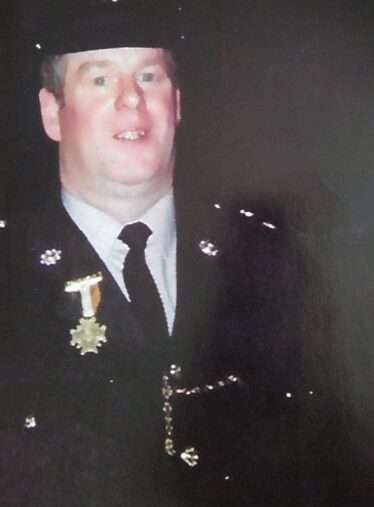
Garda John (Sean) Leonard awarded Scott Gold Medal 1988. Photo courtesy of Sean Leonard’s family.
Garda Michael Hynes (Knockshanbally).
Michael Hynes was born in, Knockshanbally, Moycullen and joined the force in 1966. After completing his training in Templemore he was stationed in Tipperary town. He was then transferred to Ardfinnan, South Tipperary where he remained until 1970. He then transferred to Rathfarnham Station in Dublin and remained there until 1982. After his promotion he moved to Brockage, County Donegal and retired from there in 1998.
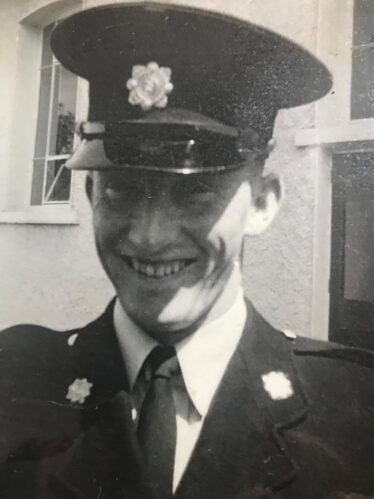
Garda Michael Hynes. Photo courtesy of Michael Hynes
Garda Seamus Lydon (Drummaveg).
In 1972 Séamus Lydon from Moycullen joined An Garda Síochána. He completed his training in Templemore and was first stationed in Kiltimagh, Co. Mayo carrying out routine garda duties.
Like many Gardaí who were seconded on temporary transfer to other places when the need arose, whether it be to help out at the Galway Races, An Fleadh Ceol or border duties, Séamus found himself on border duty dealing with much busier and volatile situations. Trouble in Northern Ireland had accelerated in the early years of the 1970s. Civil Rights marches were taking place and riots, bombings, sectarian murders and shootings were almost a daily occurrence. Séamus was stationed at Dundalk and Dromad during this time. His duties at the time, he said, were to help “maintain law and order in our jurisdiction.”
In September 1973 Séamus returned to Kiltimagh and resumed his duties. As a 19-year-old in his first year as a young garda he had encountered situations which many would never experience in a lifetime. It did not end there, however, as the following two years of 1974 and 1975 saw him on border duty again in Lifford, County Donegal. He said, “Border duty was very trying and it was a difficult time for our State and the security forces. The troubles in Northern Ireland were out of hand and the spread of violence down South was a real threat.”
After this tour of duty, Séamus’s life settled down to normal Garda duties. Over the years he served in several stations namely, Kilkelly, County Mayo and An Daingean, County Offaly, until he returned to Galway, the county of his birth, where he was stationed first at Menlough, then Galway City (when the garda station was located in Eglington Street), and finally in Oughterard from where he retired in 2011. Séamus said he has so many happy memories of being a member of An Garda Síochána … “I made wonderful friendships and served with great colleagues, some of whom I will never forget” and equally important was “being part of the community you served.”
Seamus’ uncle Mark Lydon also from Moycullen was a member of the force and retired as a sergeant in 1969. Four of his cousins also joined the force. The connection with An Garda Síochána continues today as Séamus’ son, Patrick, is married to a serving Garda based in Galway.
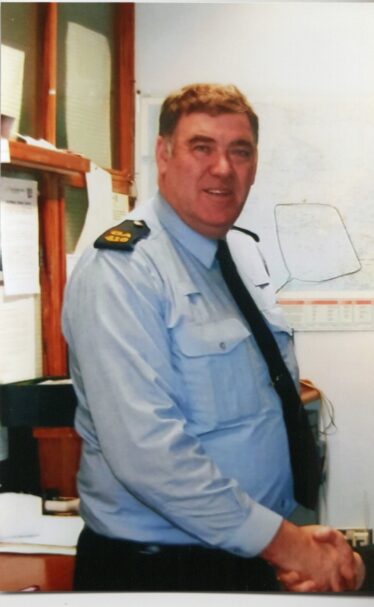
Garda Seamus Lydon. Photo courtesy of Seamus Lydon
Seamus shared one of his many experience as a Garda.
In the line of duty
Seamus Lydon had signed in for duty at Oughterard station one evening in late October, many years ago, when he was informed by a garda based at Salthill Station that a broken phone call message from a person with very poor English saying that he was locked in a castle somewhere near the town of Oughterard had just been received. Immediately, Seamus guessed this had to be Aughnanure castle, located about 3 miles from the town. Seamus took up the story. He said, ‘’I arrived at the castle which was down a secluded laneway surrounded by bushes, shrubs and farming land, no houses. It was getting dark as I checked around the castle and saw that it was securely locked up and there was no visible sign of entry and there was no one around. As I could not gain entry and needed to check the castle, I contacted the caretaker and key holder and informed her of the situation. She informed me that the castle was closed to visitors by the Office of Public Works at this time of the year and would not be open again until April the following year. She agreed, however, to meet me, but it would take her about an hour or so to get to the castle. I agreed to wait for her there.
While I was waiting, I walked around the grounds and checked the castle for other entry points. I called out but there was no answer. I continued calling as I walked down the field at the back of the castle towards a circular stone building, like a watchtower. The building had very narrow slit windows and a very solid door. As I came closer, I was aware of a sound coming from within. I opened the door by lifting a heavy steel circular handle. Inside I found two clearly distressed and terrified teenagers. They had been really trapped with no hope of escape as the latch had closed on the outside. Their relief on seeing me was something I shall never forget. They were from France and had intended to go to Clifden, they were only passing through, but had missed the bus and decided to explore the castle instead. The battery on their mobile phone was almost depleted and to add to their woes the reception was extremely poor.
I brought them back to Josie Walsh at The Boat Inn who gave them refreshments and a meal after their ordeal. They realised, as did I, that things could have turned out very differently. Poor telephone reception, depleted battery, the garda at Salthill not hearing or understanding their message and therefore not being able to establish the facts, if the keyholder was unavailable, the remoteness of the place, and the fact that the castle would not reopen until the following year would all add up to a tragedy.”
Fortunately, because of good gardaí work, all was well that ended well!
Interview with Retired Garda Seamus Lydon by Moycullen Heritage.
The extended Lydon Family
Mark Lydon, who came from Dromabheag (Drummaveg), Moycullen joined An Taca Síochána in 1939. This was a temporary police force created to supplement An Garda Síochána during the emergency period and was disbanded after World War 2. He then became a member of An Garda Síochána. He retired from Carrickmacross Garda Station in 1969 at the rank of sergeant. After his retirement Mark returned to live in his native Moycullen.
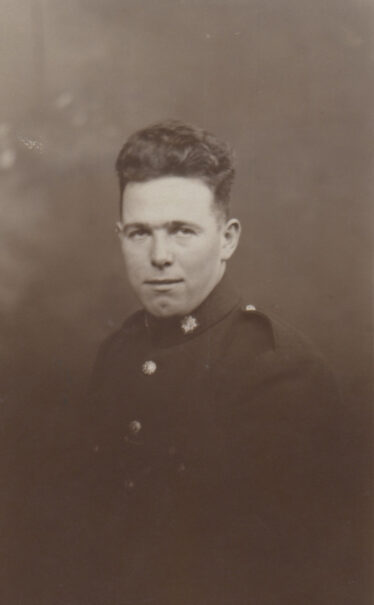
Garda Mark Lydon, 1935. Photo courtesy of Seamus Lydon
Mark Lydon’s sister, Julia, married Peter O’Halloran and four of their children went on to join the force. Martin O’Halloran joined in 1954 and retired as a superintendent in Naas in 1988. Andrew joined in 1965 and died in 1996 as a serving member at Tullyvin Garda Station. John joined in 1958 and retired as a superintendent in Sligo and Christy, who also joined in 1958, retired as a sergeant from Monasterevin Garda Station in 1989.
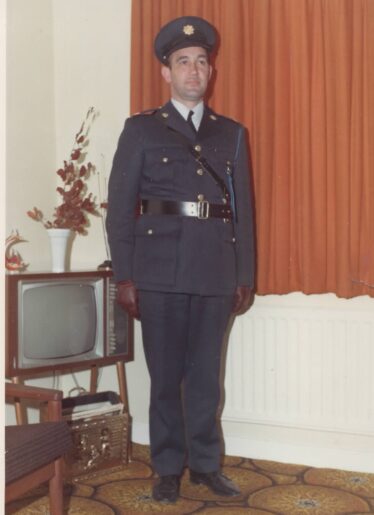
Garda Martin O’Halloran. Photo courtesy of Seamus Lydon
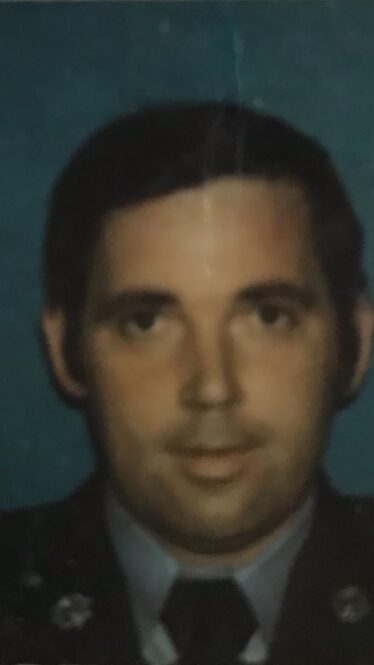
Garda Andrew O’Halloran. Photo courtesy of Seamus Lydon
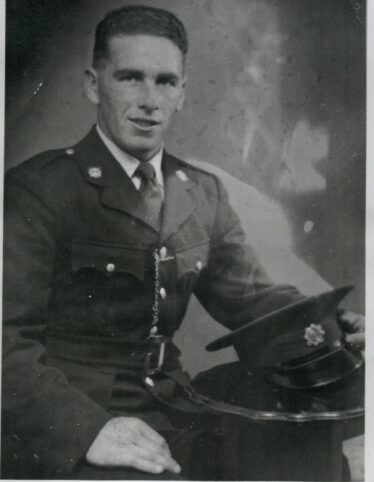
Garda Pat Melia, Knockshanbally. Courtesy Mary Fox
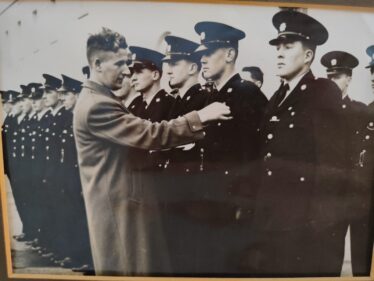
Garda Sean O’Connor, Kylebroughlan. Courtesy of Moycullen Heritage
Róisín O’Dea (Cloonnabinnia), and the Garda Mounted Support Unit
Róisín O’Dea, from Moycullen, always had a great love of horses and had been riding from a young age. When the Garda Mounted Support Unit was formed in 1998 six men and two women were recruited, one being Róisín. The unit, based in the Phoenix Park, Dublin has a national remit. Its role includes high visibility policing patrols, crowd control and public order, community policing and some ceremonial work.
The unit uses the Irish draught horse breed, but temperament and physical attributes are an essential characteristic of any police horse. A lot of time and work goes into training the horses and exposing them to the type of situations they will encounter.
Bean áitúil Mhaigh Cuilinn, Róisín O’Dea, agus aonad tacaíochta maraíochta an Gharda,
Bhí grá i gcónaí ag Róisín O’Dea, as Maigh Cuilinn, do chapaill agus bhí sí ag marcaíocht ó aois óg. Nuair a bunaíodh Aonad Tacaíochta Marcaíochta an Gharda i 1998 earcaíodh seisear fear agus beirt mná, Róisín duine acu. Tá an t-aonad, atá lonnaithe i bPáirc an Fhionnuisce i mBaile Átha Cliath ina sainchúram náisiúnta. Áirítear ar a ról patróil ard-infheictheachta póilíneachta, rialú sluaite agus oird poiblí, póilíneacht phobail agus roinnt oibre searmanais.
Úsáideann an t-aonad pór capall na hÉireann, a bhfuil an meon agus na tréithe fisiceacha tréithe ann atá riachtanacha do chapaill póilíneachta. Téann go leor ama agus oibre isteach i dtraenáil an capaill agus iad a réitigh do na cúrsaí a bhéas amach rompu.
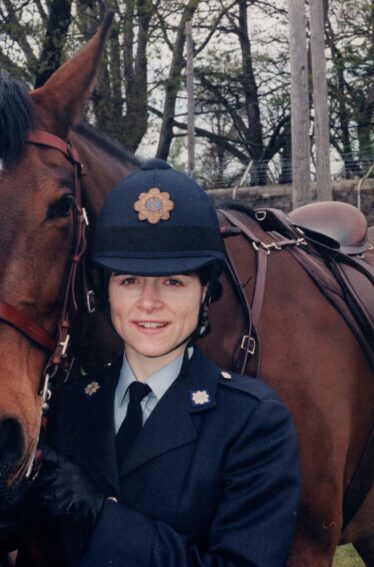
Garda Róisín O’Dea as part of the first group of Irish Mounted Gardaí. Photo courtesy of O’Dea Family
Garda Senan O’Sullivan (Gortyloughlin).
Garda Senan O’Sullivan followed in his father, Garda Mattie O’Sullivan’s footsteps and completed his training at the Garda Síochána Training Depot in Templemore, County Tipperary in February 1984. He was stationed at Henry Street in Limerick.
Like all Gardaí his duties were many and varied. On one occasion, which appeared in the press, he was part of a massive security operation outside Barringtons Hospital, Limerick, which was mounted when several high risk prisoners slashed their wrists and arms with razor blades as they wanted to be transferred back to Mountjoy Prison, Dublin.
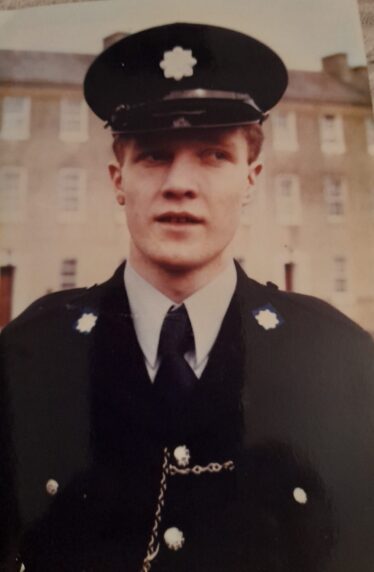
Garda Senan O’Sullivan Templemore 1983 Photo courtesy of O’Sullivan Family
Garda James Walsh (Lealetter) 1929-2017 Garda Reg. No.10511B.
Born in Lealetter, Moycullen on the 2nd of February 1929, James left Moycullen in search of gainful employment in London at the age of 16 years. He worked in construction for some years until he returned to commence his Garda training in Garda Headquarters Phoenix Park, Dublin. Subsequently he was stationed around Dublin at College Street Garda station, followed by a long stint in Terenure Garda station and latterly in Dundrum Garda station. He retired as a Garda Sergeant after 30 years service.
During his career he featured on the Gardaí teams for handball, hurling and football and even turned his hand to boxing and golf in his later years as a member of the Stackstown Garda Club. He married Moira in 1958 and had five children. Although nicknamed ‘The Rock’ by his peers, James was somewhat of a gentle giant who was devoted to his family all his life. Together the family enjoyed many happy summers over the years in Moycullen.
He settled in Dublin but preferred to spend his spare time in Galway than anywhere else in the world. He never forgot his roots in Moycullen and was at home cutting his bog every year in the Dublin mountains, which must have reminded him of where he came from. He loved fishing and knew the lakes of Conamara like the back this hand. He always kept contact with his family and friends in Moycullen and spoke the Irish language at every opportunity.
Courtesy of his daughter Maureen Walsh.
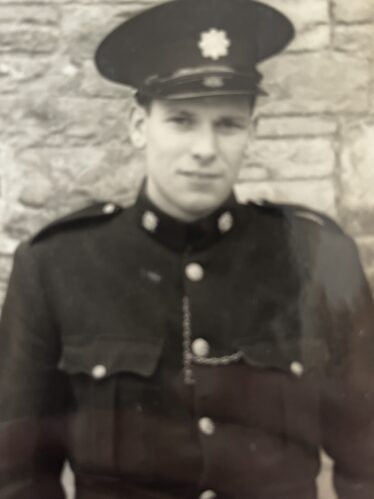
Garda James Walsh, Lealetter. Photo courtesy of James Walsh’s family.
Garda Liam Walsh (Kylebroughlan).
Garda Liam Walsh (Kylebroughlan) joined An Garda Síochána in 1962. He served in Donnybrook Station, Dublin in 1963 and Pearse Street Station, Dublin in 1978. Later in his career, in 1986, he became a Chief Superintendent and was based in Garda Headquarters at the Phoenix Park, Dublin. He retired in 1999.
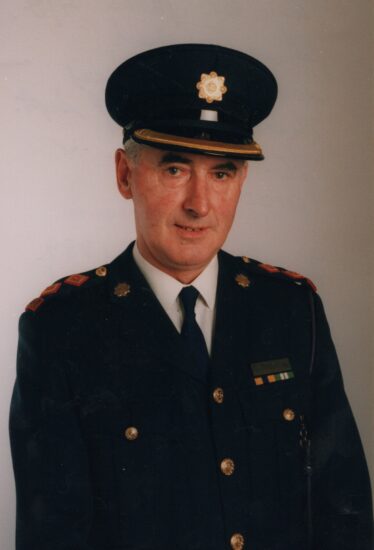
Chief Superintendent Liam Walsh. Photo courtesy of Liam Walsh.
No Comments
Add a comment about this page