
Biography
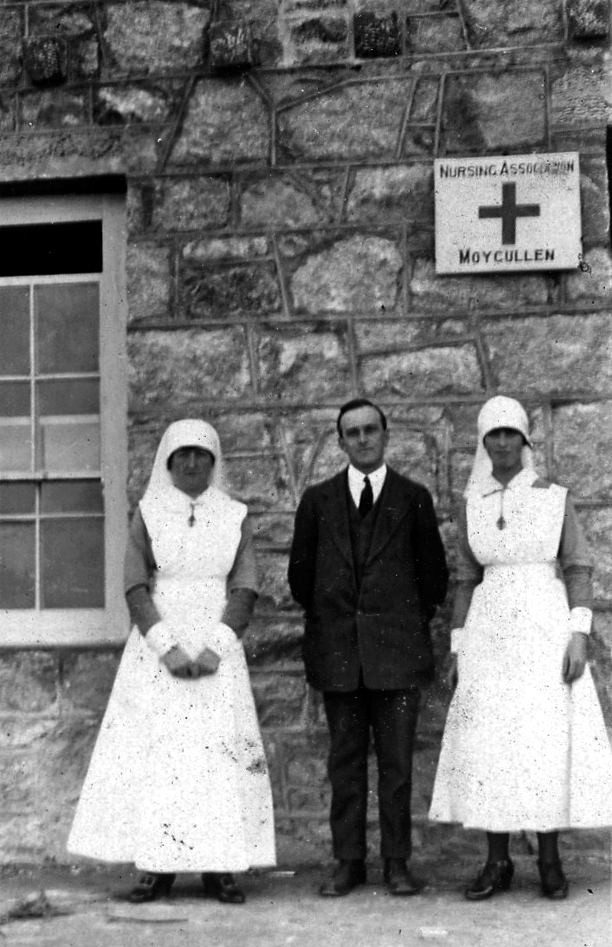
CR KilKelly with Jubilee Nurses for Moycullen and Killanin outside the Co-op Building Moycullen
Mary Margaret (O)Doherty was born on 19th June, 1891, in Gortnadieve, Co. Roscommon in the parish of Glenamaddy, Co. Galway to parents Michael and Margaret (née Corrigan) Doherty. Sadly, Margaret died shortly after she gave birth to Mary Margaret on 19th June, 1891. Her death certificate states that she died ‘suddenly after confinement and there was no medical attendant present’. Mary Margaret had three siblings, Patrick, James and Ellen Josephine. According to the 1901 census, all children, described as scholars, were living with their widower father at that time. Mary Margaret’s early education was at Gortnadieve National School where her father was a teacher. By 1911 census, Mary Margaret was the only one recorded at home, aged 19 years. She died on 17th November, 1950 having worked in Moycullen, Co. Galway as a Jubilee Nurse for fourteen years. She is buried in Moycullen graveyard.
Career
Mary Margaret Doherty trained as a Queen’s nurse at the Royal South Hampshire and Southampton
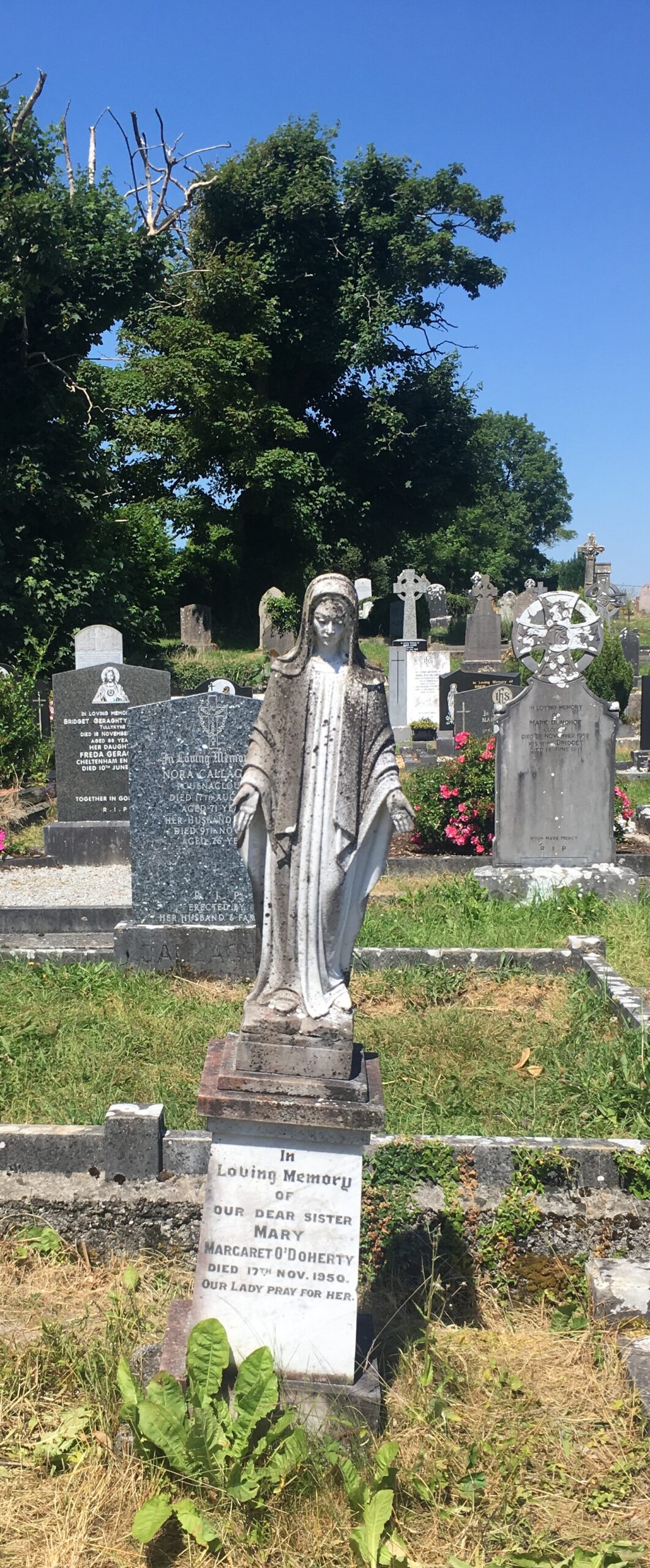
Grave of Mary Margaret O’Doherty, Jubilee Nurse Moycullen 1929-1950
Hospital from 9TH July 1923- July 19th 1927. From 9th September 1927 to 9th March, 1928 she carried out her midwifery training at Chesterfield Maternity Home and in May of that year obtained her C.M.B. Certificate. Following on from her midwifery training, Mary Margaret did her District Training at Sheffield D.N.A. from March 10th until 9th September 1928. Whilst there she attended lectures in hygiene, domestic sanitation and midwifery. She was described by her Superintendent, as ‘a very good reliable nurse, rather stolid, but good-natured and willing’. The Inspector’s report describes her as ‘a conscientious and reliable nurse with a pleasant manner but does not, at present, realise the educational possibilities of the work’. Mary Margaret was appointed a Queen’s Nurse on January 1st, 1929. She continued to work in Sheffield until October 1929 and then transferred to Staveley, a small village in the South Lakeland district in Cumbria. Here her reputation for good conscientious work and pleasant manner was also noted but with the added merit of being ‘an excellent midwife’. In October 1931 Mary Margaret was transferred to the Irish Branch of the Queen’s Nurses and after five years’ service in Londonderry, as it was recorded at the time, she transferred to Moycullen in Co. Galway, 1936 where she carried out her ‘duties as a Jubilee Nurse for fourteen years’(Connacht Tribune 16/12/1950). Mary Margaret was the recipient of the Gold Badge of the Queen’s Institute of District Nursing in Eire for her 21 years of service as a Jubilee Nurse in England, Northern Ireland and Moycullen. In her obituary it was stated that ‘that her kindness and attention to the people of Moycullen and Killanin district requiring her services, will long be remembered in that area’ (Connacht Tribune16/12/1950).
Ellen Josephine O’Doherty
In researching Mary Margaret Doherty, it has been interesting to discover that her sister Ellen Josephine also became a Jubilee Nurse. In fact, it appears that both sisters were appointed Queen’s Nurses on January 1st, 1929. Ellen Josephine was a year older than Mary Margaret. She followed exactly the same career path as her younger sister and like her took up her position as Jubilee Nurse in Moycullen in September, 29th, 1936. Where Ellen was described as a cyclist under the other qualifications section of the Queen’s Nursing Institute Roll of Nurses, Mary Margaret was described as a cyclist but ‘not very proficient’. Moycullen Heritage has also discovered that the two sisters are buried in a double grave in Moycullen. So, as they were together in life, they are together in their final resting place, in Moycullen Graveyard.
Mr. John Kilkelly
‘Under the will of the late Mr John Kilkelly, late solicitor to the Co.Council, which shows assets to the amount of £6,000, the income of this sum is directed to be paid annually to the extent of £200 for the purposes of endowing beds in hospitals, and in connection with the Jubilee Nursing to maintain two trained nurses to attend poor patients without distinction of class or creed in the parishes of Moycullen and Killanin, Co. Galway…. The local trustees should be Colonel Randolph Kilkelly, M.D. James Donohoe, farmer, of Moycullen and Patrick Curley, farmer, of Killanin. (The Galway Observer, Saturday December 4th 1920)’. The first Jubilee Nurse came to Moycullen in 1919. Her name was Sarah Greene-Keenry. Initially the Jubilee nurses lived at Drimcong House, home of the Kilkelly’s, but later they moved to The Co-op building and eventually lived and had their dispensary in the former RIC building which had been reconstructed after fire in the early 1920s and bought by Mr Kilkelly. Today it is known as The Whitegables.
An Bean Cabhrach ( The Handy Woman)
On some occasions and particularly in rural areas, it was difficult to have access to a professional midwife or nurse. In this case women and the sick often relied on the help of another local woman known in Moycullen as An Bean Cabhrach, The Handy Woman. One such woman was Máire McDonagh from Knockerasser, Maigh Cuilinn. What follows is an account of her experiences as such by her great granddaughter, Paula Lydon.
Máire McDonagh -Bean Cabhrach
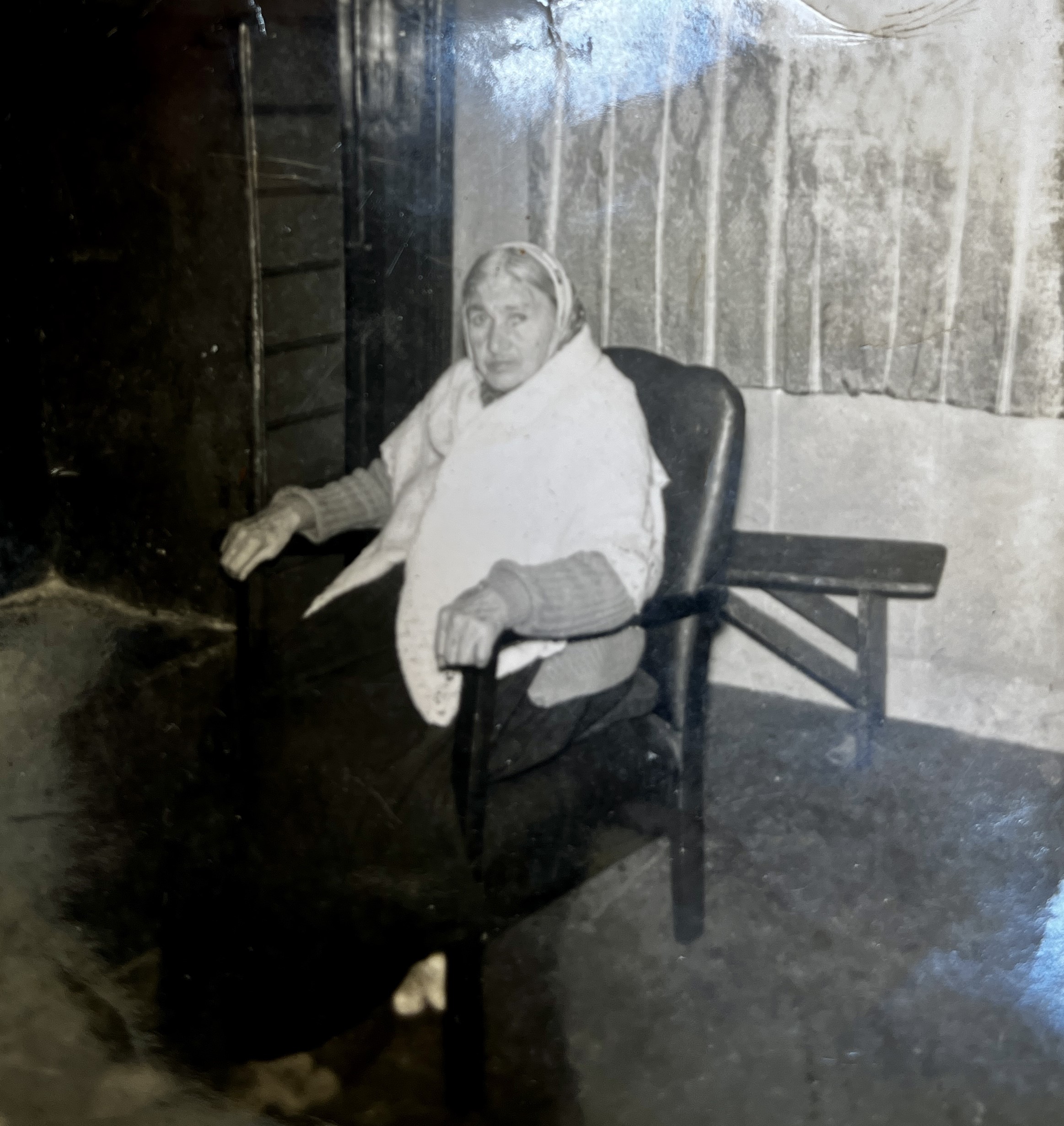
Máire McDonagh worked as a Bean cabhrach (handy women) to help woman in childbirth, the sick and dying.
Máire McDonagh ( nee Thornton) was born in An Spideal in the late 1870’s. She married John
McDonagh in 1899 and moved to Knockerasser. They lived with her mother-in-law Julia. They had
eight children ( Pat, Ned, John, Watt, Andrew, Mary, Julia & Margaret) Pat, Ned and Margaret
emigrated to America and the other family members settled locally. Her husband John died in 1944
aged 75 and her son Andrew died in 1949 aged 30.
Máire was my maternal great grandmother, and these are my mother’s memories of her and some
other stories. She was known as Grandma to all her grandchildren and to several other children in
the village as well. My mother and her siblings all remember her fondly as they grew up with her in
the house. She had a very caring nature.
Máire was often called to attend women in labour in her own villages and other villages. Sometimes
she went alone and other times she had another local woman with her. This usually involved helping
during labour and staying on after the birth to help with general chores around the house. Over a
long number of years, she attended the births of neighbouring children , her niece and nephews ,her
grandchildren and even her great grandchildren.
At the time there was a district nurse in Moycullen and Spiddal but due to the distance and lack of
motorised transport it sometimes happened that a baby arrived before a nurse, or a doctor could
attend. Many babies were born at home at that time, and it wasn’t until the 1950’s that more
women started to have their babies in the hospital. In the early 1940’s my own paternal
grandmother had arranged to give birth to my father in the hospital and when she we went in to
labour a neighbour was tasked with the job to go to Moycullen village to get the local taxi to bring
her into Galway. As he was unaccustomed to the idea of a hospital birth, he arrived back in the taxi
with the district nurse and my father was born at home.
No formal training
Máire had no formal training but she had years of practical experience. It is my understanding that
she attended with someone and learnt from them, and they then they passed on mantle to her. At
one stage there was a difficult birth and by the time the doctor arrived Máire had safely delivered
the baby. The doctor highly commended her for what she had done and said that he wouldn’t have
overseen it any differently. This story was told to my mother by her older cousin who was told this
by her mother (Máire’s daughter) On another occasion she was attending the birth of a relative’s
child and someone in the house died suddenly on the same night. She ended staying there for an
extended period of time to help the family.
The job of getting water from the well
While there was a lot of superstitions surrounding childbirth my mother doesn’t recall her
grandmother ever talking about such matters. During the childbirth, the children and men were
usually dispatched off somewhere else away from the house. On one occasion while the District
Midwife was at a house a neighbour who was visiting the house was slow to take the hint to leave.
Finally, he was given the job of getting water from the well and each time he returned he was sent
off again. This continued until the baby arrived. Sometime later he was visiting another house, and
the District Midwife arrived. He made a hasty departure saying that someone else could draw the
water this time that he wasn’t going to get caught doing it.
The christening
At the time the child was baptised within a day or two of the birth and usually the mother was not
present at the baptism as the tradition was, they did not enter a church until they had been
‘churched’ . Máire sometimes attended the christening to look after the baby or stayed with the
mother. She was well regarded and was often called upon to help not alone with babies but also ifsomeone was sick in a house. My mother recalls going visiting with her to a neighbour’s house to
visit a new baby and she called in to check on another neighbour who had been discharged from
hospital on the way.
Visiting those who were sick
When she wasn’t assisting at a birth, she was often called upon to visit those who were sick or
coming to the end of life. The tradition was that people tended to give round the clock care to
someone who was extremely sick, and she often stayed at night to sit with extremely ill people.
Once a person had passed away, she helped to prepare the corpse for the funeral and stayed in the
house to aid the grieving family.
Transport
Transport at the time was by horse and trap or walking. My mother recalls her walking from Spiddal
through the mountain after visiting relatives when she was in her early seventies. She lived to the
ripe old age of eighty-nine and enjoyed good health until her later years.
Besides her ‘nursing’ duties
As well as her ‘nursing’ duties she also had an active interest in sowing vegetables and tending to the chickens, turkeys and geese. One of her specialities was the ‘Little Goose’ on Christmas Eve where she made a black pudding from giblets , gizzard of the goose and this was eaten on Christmas Eve. The full goose was on the menu Christmas Day. She was not keen on rich food and after all the indulgences of the Christmas when the diet returned to normal, she would declare that there was nothing like the
‘beatha garbh’ or plain food. During the winter she spent the evening’s knitting socks and she taught
my mother how to knit with knitting needles made from the quills of the goose. (She was a good
teacher as my mom hasn’t stopped knitting or crocheting since)
Acknowledgement
The stories about her Grandma Máire and topics were related to me by my mother Maisie Lydon.
This is just a selection of stories and memories of Máire and I’m sure there are many more. There
were many bean cabhrach (handy women) like Máire in communities all around the country who
gave a helping hand to family and neighbours and supported each other through childbirth and
family life during tough times. It is wonderful to see them acknowledged through projects like this
and hopefully we will hear more of their stories.
No Comments
Add a comment about this page