
Limestone, Fossils, and Farming
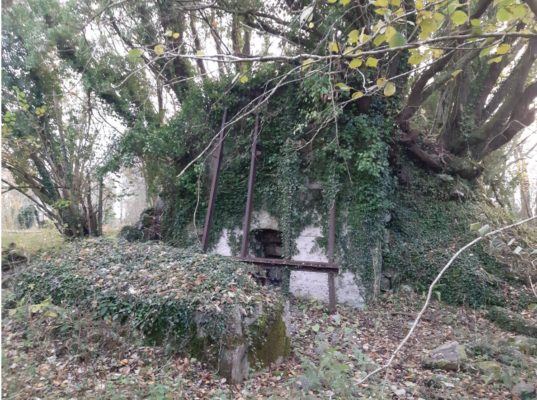
Lime burning is one of Ireland’s oldest technologies. In Ireland, lime was probably in use from the early medieval period, when monks built churches and round towers with lime mortar.
By the eighteenth and early nineteenth centuries, small farm lime kilns became part of the rural landscape. Ordnance Survey maps show just how common they were — in some places, thousands dotted the countryside. They may be marked as L.K on the map but are sometimes not named and they are depicted as a small circle with a darkened portion defining the stoke-hole. In the Moycullen they were especially concentrated in the Clooniff area.
From here, lime could easily be transported by boat into Galway city. Stone was also transported to other places within the village. There are lime kiln showing on the map in Drimavaughan, Drumaveg, Pillagh, and, according to Mattie Lydon, another in Seanadh Eadain, which doesn’t appear on the map. The limestone was transported by horse and cart from Clancy’s Quarry in Addragoole and burned in the local kiln. This means the fossils within the limestone were also transported from the Taobh Mín to the Taobh Garbh.
How a Lime Kiln Worked
Most farm kilns were simple, stone-built structures set into a bank. Limestone was broken into lumps and loaded into the kiln from above, mixed with layers of fuel — usually turf from nearby bogs, though charcoal, coke, and wood were sometimes used.
Inside the kiln, temperatures needed to reach between 900–1200 ºC. The kiln was packed with alternate layers of turf and small pieces of limestone; the bottom layer of turf lit first. As the fire spread upwards, more layers of stone and fuel were added until the kiln was full. It could take up to 48 hours for all the limestone to be reduced to quicklime.
After the burning was complete, the kiln was left to cool for two or three days before being emptied. The finished lime was raked out from the base and placed in bags or barrels for sale or home use.
Everyday Uses
Quicklime had many uses:
-
Farming – spread on fields , added to compost heaps, and used to disinfect wells and sheds.
-
Building – the essential ingredient in mortar, plaster, and whitewash.
-
Household – kept potatoes from rotting in storage and even treated animal diseases like foot rot.
Folklore and Belief
Lime kilns were not only practical but also mysterious places. In Ancient Legends, Mystic Charms and Superstitions of Ireland, Lady Francesca Wilde records a tradition:
“If a ball of worsted is thrown into a lime-kiln and wound up till the end is caught by invisible hands, the person who winds it calls out, ‘Who holds the ball?’ and the answer will be the name of the future husband or wife. But the experiment must be made only at midnight, and in silence and alone.”
A Vanished Tradition
In the late 19th century, local lime burning declined as industrial kilns and imported fertilisers took over. The small farm kilns of Moycullen and elsewhere fell into disuse, many lost to time. But the ruins that survive — like the kiln at Homefarm, Moycullen — are lasting reminders of a time when limestone, and the fossils within, travelled around the village from the Taobh Mín to the Taobh Garbh.
Access is via private property with owner’s permission only.
No Comments
Add a comment about this page